

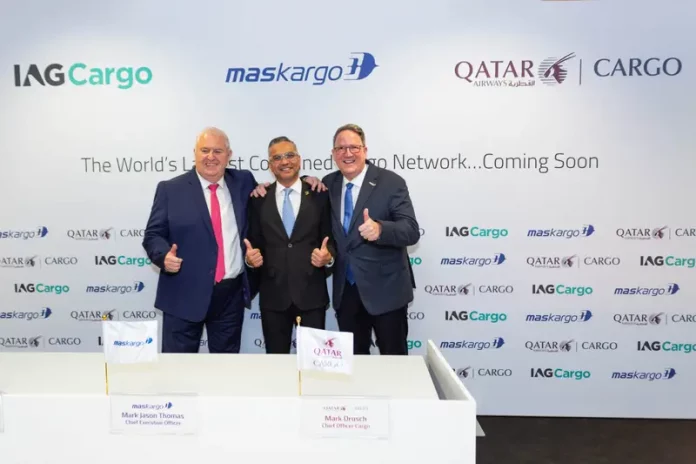

In a major development for the air cargo industry, Qatar Airways Cargo, IAG Cargo, and MASkargo have announced the launch of a global joint business aimed at redefining cargo logistics, customer experience, and humanitarian aid delivery. The announcement was made at Air Cargo Europe 2025 in Munich.
The partnership brings together three of the world’s leading cargo carriers in a strategic alliance built on three core pillars: a unified global network, seamless operational integration, and a shared philanthropic mission.
With a combined fleet of over 900 aircraft, including more than 30 dedicated freighters, the alliance will connect over 400 destinations through key hubs in Doha, Madrid, Heathrow, Dublin, Kuala Lumpur, and a sixth hub to be announced. The joint network enables up to 90,000 unique origin-destination pairings, offering access to routes that were previously fragmented or unavailable.
“This is an unprecedented level of integration in air cargo,” said Mark Drusch, Chief Officer Cargo at Qatar Airways Cargo. “We’re creating seamless global access—from a small business in Borneo to a customer in Indianapolis. This alliance makes that possible.”
The partners also emphasized operational enhancements designed to reduce friction and improve the customer journey. David Shepherd, CEO of IAG Cargo, highlighted the integration of booking platforms, enabling real-time tracking, uniform service levels, and future shared product offerings. “This is about more than scale. It’s about delivering choice, consistency, and simplicity to our customers,” he said.
The alliance will also leverage the Avios loyalty currency, allowing customers to earn and redeem rewards across the entire joint network—an unprecedented step in air cargo.
Beyond commercial operations, the joint business includes a humanitarian component: the three carriers have pledged 1,000 metric tons of free cargo capacity over the next three years to the World Food Programme (WFP). The support will help deliver food and supplies to conflict and disaster-stricken areas, including regions where traditional supply chains are limited or disrupted.
“We’re not just delivering cargo—we’re delivering hope,” said Mark Jason Thomas, CEO of MASkargo.
Virginia Arribas, Deputy Director of Private Partnerships at the World Food Programme, welcomed the announcement: “In countries like Afghanistan, Sudan, Gaza, and Ukraine, logistics is a lifeline. This partnership will help us reach more people, faster and more effectively.”
The joint business is expected to go live in the coming months, pending regulatory approvals. It represents a bold step toward a more connected, efficient, and humanitarian-focused future for global air cargo.