

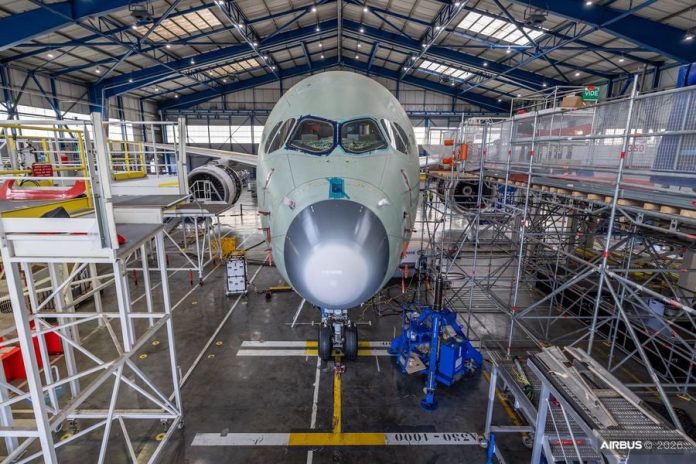

Airbus has achieved another major milestone in the development of its A350F freighter programme after successfully completing Ground Vibration Testing (GVT), bringing the next-generation cargo aircraft closer to its first flight.
The three-day test campaign, conducted in Toulouse in June, is a critical step in the aircraft’s certification process, providing engineers with essential data to validate structural behaviour and aeroelastic performance before flight testing begins.
Ground Vibration Testing evaluates how an aircraft responds to controlled vibrations, allowing Airbus engineers to refine computer models that predict structural loads and performance across the aircraft’s full flight envelope.
Following the successful completion of the tests, Airbus confirmed that the results provide a key validation step required before the A350F enters its flight test programme.
Nicolas Lastere, Airbus loads and aeroelastics expert, described the testing as a “key enabler” for the aircraft’s maiden flight, providing critical evidence to validate the aeroelastic models required for certification.
Extensive Testing Campaign Completed
Preparations for the Ground Vibration Test began days before the campaign, with Airbus teams installing hundreds of sensors, data acquisition systems and electrodynamic shakers, while also configuring and weighing the aircraft.
The A350F was tested through two controlled vibration methods. External shakers were positioned at key areas of the aircraft, including the wingtips, engines and rear fuselage, while the aircraft’s own flight control surfaces were programmed to generate controlled sine-wave movements across different frequencies.
A large network of accelerometers monitored the aircraft’s response, enabling engineers to accurately identify its structural characteristics.
Airbus also introduced an innovative testing approach by combining data from the aircraft’s Flight Test Instrumentation (FTI) with additional autonomous sensors installed specifically for the GVT campaign. This approach helped improve efficiency and reduce the overall testing timeframe.
Fabien Ayme, Airbus aeroelastic testing expert, said engineers monitored the aircraft’s behaviour in real time, analysing results after each test run to confirm findings and optimise subsequent test sequences.
Test Results Validate Design Models
Airbus confirmed that the Ground Vibration Test generated high-quality data, with the aircraft’s measured behaviour closely matching the theoretical models developed during the design phase.
The milestone represents the result of approximately two years of preparation involving specialists across Airbus, including teams from the Final Assembly Line, Flight Control Systems, Flight Test Instrumentation, Vibration Testing, Aeroelastics, Tooling Development, Mass Properties and Quality departments.
Lastere said the achievement demonstrated Airbus’ decades of expertise in vibration testing, with advanced measurement techniques and real-time data analysis helping to keep the A350F programme on schedule.
Flight Testing Next for A350F
Following completion of the Ground Vibration Test, Airbus engineers will continue analysing data and refining computational models ahead of the next certification phase.
The aircraft will then undergo Flight Vibration Tests, also known as flutter testing, during the initial three months of its flight test campaign.
These tests will gradually expand the A350F’s operational limits, including evaluations at maximum dive speed and Mach number, before regulatory authorities grant approval for commercial operations.
Airbus said the successful completion of the Ground Vibration Test provides further confidence in the A350F’s structural integrity and aeroelastic performance, establishing a strong foundation for the aircraft’s upcoming flight test programme and eventual entry into service.