

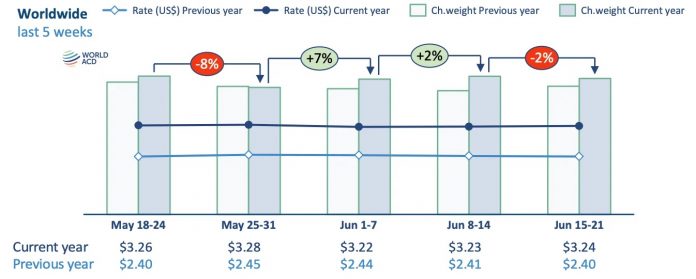

Rates stay high despite further capacity returning to Gulf markets
Worldwide and regional air cargo rates have remained high despite further capacity returning to Gulf markets since the latest ceasefire and peace memorandum between Iran and the US, effective since 17 June.
According to the latest weekly figures from WorldACD Market Data, average global air cargo rates edged upwards by +1% in week 25 (15 to 21 June) to US$3.24 per kilo, based on a mix of spot rates and contract rates, with average prices more or less stable from all the world’s main air cargo origin regions, on a week-on-week (WoW) basis. Compared with this time last year, average worldwide rates are currently +35% higher, led by a +50% year-on-year (YoY) increase from Middle East & South Asia (MESA) origins, and a +37% YoY rise from Asia Pacific origins.
Average worldwide spot rates also edged up by +1% in week 25 to $3.75 per kilo, taking them +47% higher than the equivalent week last year, with both MESA (+52%) and Asia Pacific (+51%) origin spot rates more than one-and-a-half times their level this time last year. Average spot rates from MESA origin regions had softened by around -5% in weeks 23 and 24 compared with their level at the end of May, but they rebounded slightly (+3%) in week 25 to $4.16 per kilo – despite a rise in air cargo capacity (+6%, WoW) from the region that outpaced WoW rises in tonnages (+2%, WoW).
MESA capacity rebuilds further
The signing of the MOU agreement between the US and Iran on 17 June has clearly boosted the continuing recovery of air cargo capacity to and from MESA, significantly further narrowing the capacity deficit this region has experienced since the US and Israel attacked Iran at the end of February. The capacity deficit compared to the levels in week 7 narrowed from around -30% in week 24 to just -19% in week 25, with positive developments for each subregion.
For example, the capacity deficit between MESA and North America was slashed from -28% in week 24 to only -10% in week 25, an improvement of 18 percentage points in just one week. Meanwhile, from MESA to Europe it narrowed from -21% to -11%, and to Asia Pacific the capacity gap was cut from around -31% to -20% – figures more consistent with the average +11% pts WoW improvement.
For the Gulf area specifically, the capacity deficit between the Gulf area and North America narrowed from -33% in week 24 to just -13% in week 25, compared with the pre-war levels of week 7, a +20% pts WoW improvement. There were some pretty big changes for other markets as well, with the second biggest change being between the Gulf area and Asia Pacific, where the capacity deficit narrowed from -51% in week 24 to -35% in week 25, a +16% pts WoW recovery.
Another big change in week 25 was the substantial return of air cargo capacity between the Levant & Caucasus sub-region and the MESA region more broadly, where the capacity deficit dropped from -34% in week 24 to just -4% in week 25, a +30% pts WoW recovery in just one week, as Gulf carriers and other airlines reopened previously suspended or part-suspended services within the region.
Limited effects on rates
Looking specifically at the MESA to Europe market, the returning capacity did relatively little to subdue the highly elevated spot rates seen since the war began around 18 weeks ago. Capacity from MESA to Europe rose by around +13% in week 25, far outpacing the +2% rise in chargeable weight, but average spot rates remained almost unchanged at $3.76 per kilo, a decline of just -1%, WoW. Capacity from the Gulf to Europe rose by around +20%, WoW, in week 25, while chargeable weight from key Gulf markets to Europe actually declined by around -25%, WoW. Despite that mismatch in the supply and demand dynamics in week 25 from the Gulf to Europe, spot rates held relatively firm, with rates from Dubai to Europe dipping by around -8%, WoW to around $3.79 per kilo – more than double (+106%) their level this time last year.
Those highly elevated spot rates are in part a reflection of the continuing volatility and uncertainty in the capacity and demand landscape, the greater role of freighters in the provision of capacity due to the continuing deficit of passenger bellyhold capacity, and higher costs associated with higher jet fuel prices and risk surcharges. For rates to drop back significantly towards pre-war levels will presumably require the current truce between the US and Iran to be maintained sufficiently to enable some genuine longer-lasting stability to return to both air cargo and airline passenger markets.
Jet fuel prices, meanwhile, have continued to moderate in week 25. Having dropped by around -5% the previous week, average worldwide jet fuel prices in the week ending 19 June fell by a further -14%, WoW, to $119 per barrel, according to IATA’s Jet Fuel Price Monitor, which is based on the latest price data from Platts. That’s around -24% below their average level in May, but it remains around one third (+32%) higher than the average level last year.