
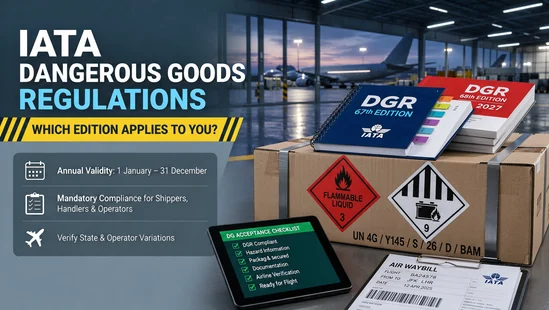
The IATA Dangerous Goods Regulations are the rulebook every air shipment of hazardous material is checked against. They change every year, and the 68th Edition takes effect on 1 January 2027.
Most guides on this subject are published by someone selling the manual or the training that goes with it. This one covers what the regulations contain, who has to follow them, what the training rules require, and whether you need to buy anything.
What Are the IATA Dangerous Goods Regulations?
The DGR is the air cargo industry’s working manual for shipping hazardous materials. It sets out how dangerous goods are classified, packed, marked, labelled, documented and accepted for carriage by air, and it is the standard against which airlines check every consignment.
It is published annually by IATA and revised each year.
The DGR is built on the ICAO Technical Instructions, which are the legally binding international requirements. IATA reproduces those requirements and adds the operational detail the industry needs, including airline and state variations that the ICAO document does not carry.
That difference matters in practice. The Technical Instructions tell you what the law requires. The DGR tells you what the airline on your lane will actually accept, which is usually the stricter of the two.
Who Has to Follow the DGR?
Anyone who prepares, offers, accepts, handles or transports dangerous goods by air. That covers shippers, freight forwarders, ground handlers, airlines and anyone packing a consignment on their behalf.
It applies by activity rather than by job title. A company that ships lithium batteries twice a year is as much within scope as a chemical manufacturer shipping daily.
The responsibility sits with the shipper first. Classification is a statement about the goods, and only the party who owns them knows what is in the package. A freight forwarder can check that documentation is consistent, and it cannot verify that the contents match the declaration.
For what this means in daily practice, see dangerous goods by air.
What Is in the DGR?
Ten sections, each covering a stage of the process. The structure is worth knowing because it tells you where to look rather than requiring you to read the manual end to end.
| Section | Covers |
|---|---|
| 1 | Applicability, shipper and operator responsibilities, training |
| 2 | Limitations, including what is forbidden and what passengers may carry |
| 3 | Classification, the nine hazard classes and their divisions |
| 4 | The List of Dangerous Goods, every UN number and its requirements |
| 5 | Packing, including the Packing Instructions |
| 6 | Packaging specifications and performance testing |
| 7 | Marking and labelling |
| 8 | Documentation, including the shipper’s declaration |
| 9 | Handling, acceptance, storage and loading |
| 10 | Radioactive material |
Two further parts carry more weight than their size suggests. The Special Provisions modify the general rules for particular substances, and the State and Operator Variations record where a country or an airline imposes something stricter.
Checking the variations is the step most often skipped. A consignment compliant with the general rules can still be refused because the operator on that route applies its own restriction.
Which Edition Is Current, and When Does It Change?
The 67th Edition applies through 2026. The 68th Edition takes effect on 1 January 2027.
Editions run on the calendar year, so the changeover is the same date every time. There is no overlap period for the DGR itself, which means a consignment tendered on 1 January is checked against the new edition regardless of when it was booked or packed.
Four other IATA manuals move on the same date.
| Manual | 2027 edition |
|---|---|
| Dangerous Goods Regulations | 68th |
| Live Animals Regulations | 53rd |
| Temperature Control Regulations | 15th |
| Ground Operations Manual | 15th |
| Compassionate Transportation Manual | 7th |
If you ship under more than one of these, all of them change together. That is relevant to anyone moving live animals or temperature controlled consignments alongside hazardous material.
Addenda are also published during the year. These correct or amend the current edition before the next one arrives, and they take effect on the date IATA states rather than at year end.
What Changes in the 68th Edition?
Batteries account for most of it, continuing the pattern of recent editions. The changes below are from IATA’s published summary of significant changes for 2027.
Lithium batteries and passenger carriage
- Power banks over 100 Wh may not be carried by passengers or crew
- Passengers and crew are limited to two power banks, even where an operator permits more than eighteen spare batteries
- Mobility aids with installed lithium ion batteries over 300 Wh carry additional operator requirements, and spare batteries are now capped at 300 Wh per device
- A new provision covers galvanically separated batteries carried by passengers
- The older lithium battery mark showing a telephone number is being phased out, though its presence alone is not grounds for rejecting a package
Sodium ion and hybrid batteries
- A new paragraph and Special Provision A235 cover hybrid batteries combining lithium ion and sodium ion cells
- The data logger exception now extends to certain sodium ion batteries
- Several Special Provisions and Packing Instructions have been amended to include sodium ion batteries
New entries
Four new UN numbers appear, covering chlorophenols and, notably, lithium metal and sodium ion batteries installed in a cargo transport unit.
Structural changes
Table 2.3.A has been split into three. Table 2.3.A for items needing operator approval, 2.3.B for items not needing it, and 2.3.C for items no longer permitted for passengers or crew. The third table is transitional and is due to be removed in the 70th Edition.
For how the battery rules work in full, see shipping lithium batteries by air.
Do You Need DGR Training?
Yes, if you are involved in any part of the process. Training is a requirement under Section 1.5 of the DGR rather than a recommendation, and it applies to the people doing the work rather than to the company in the abstract.
Since 1 January 2023 the system has been Competency-Based Training and Assessment, known as CBTA. It replaced the twelve numbered personnel categories that preceded it.
The difference is how training is scoped. The old system assigned people to a category. CBTA maps them to the job functions they actually perform, of which there are seven, numbered 7.1 to 7.7. Preparing consignments, accepting dangerous goods and flight crew duties are three of them.
An employer identifies which functions its staff perform and trains against those, rather than putting everyone through the same course.
How Often Is Recurrent Training Required?
Every 24 calendar months. The timing of the renewal affects the next expiry date, and this catches people out.
Training completed within the final three months before expiry starts its new 24 month period from the original expiry date, so nothing is lost. Training completed after expiry means the qualification has lapsed, and the new period runs from the completion date instead.
The practical consequence is that letting a qualification lapse by a week costs more than the week. It shifts the renewal cycle permanently.
What Records Must Be Kept?
Training and assessment records for at least 36 months from the most recent training, available immediately on request to the national authority or to an airline auditor.
Records need to show the employee’s name, the training and assessment dates, the job function code, the materials used, the provider’s details, a copy of the summative assessment and the certificate of competence.
Immediately is the operative word. These are produced during audits and during investigations, and a record that takes a week to locate is treated as a record that does not exist.
Do You Have to Buy the Manual?
Not necessarily, and this is worth thinking about before spending.
If your organisation classifies, packs or offers dangerous goods itself, you need current access to the DGR. The rules change annually, the variations change with them, and working from a superseded edition is the most common cause of a refused consignment.
If you ship hazardous material occasionally and your forwarder handles classification and documentation, you are relying on their access and their trained staff rather than needing your own. What you do need is confirmation that they hold both, and the training requirement still applies to anyone in your own business who packs or hands over the goods.
IATA also publishes some material free, including the lithium battery guidance document and the annual summary of significant changes. Those cover the most commonly shipped category without requiring the full manual.
The honest position is that the manual is necessary for shippers who do their own classification, and often unnecessary for those who do not. Decide which you are before buying a subscription.
How Does the DGR Relate to the ICAO Technical Instructions?
The ICAO Technical Instructions are the binding international standard. The DGR is IATA’s industry version of them, with operational detail and airline requirements added.
Where they differ, the DGR is the stricter document, because it incorporates what individual airlines and states require on top of the international minimum.
In practice, shippers and forwarders work from the DGR. It is the document airlines and ground handlers use at acceptance, so it is the one a consignment is checked against. See air cargo handling for where that acceptance check sits in the process, and air freight documents for how the shipper’s declaration fits with the rest of the paperwork.
Questions About the IATA Dangerous Goods Regulations
Which edition of the IATA DGR is current?
The 67th Edition applies through 2026. The 68th Edition takes effect on 1 January 2027, with no overlap period, so consignments tendered from that date are checked against the new edition.
What is the difference between the IATA DGR and the ICAO Technical Instructions?
The ICAO Technical Instructions are the binding international requirements. The DGR reproduces them and adds operational detail plus state and operator variations. The DGR is the stricter document and the one used at acceptance.
How often do I need dangerous goods recurrent training?
Every 24 calendar months. Renewing within the final three months before expiry keeps the original cycle. Renewing after expiry restarts the cycle from the completion date.
What is CBTA?
Competency-Based Training and Assessment, the training model that replaced the twelve numbered personnel categories on 1 January 2023. Staff are trained against the seven job functions they actually perform rather than against a generic category.
How long must dangerous goods training records be kept?
At least 36 months from the most recent training, and they must be produced immediately on request to the national authority or an airline auditor.
Do I need to buy the IATA DGR?
If you classify, pack or offer dangerous goods yourself, yes, and it must be the current edition. If your forwarder handles classification and documentation, you are relying on their access, though training still applies to anyone in your business handling the goods.