

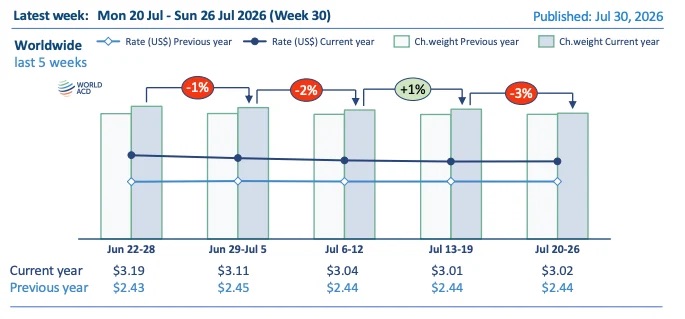

Global air cargo demand weakened in week 30 (20–26 July), with overall tonnages declining by 3% week on week (WoW), according to the latest data from WorldACD Market Data. Capacity also edged lower, down 1%, while pricing showed signs of stabilisation, supported in part by rising aviation fuel costs.
Chargeable weight fell across all major regions, led by a sharp 7% WoW drop from Africa and a 5% decline from Asia Pacific. Europe and the Middle East & South Asia (MESA) region both recorded decreases of 2%, while North America and Central & South America (CSA) saw more modest declines of 1%.
A two-week comparison (2Wo2W) reflects a similar trend, with global chargeable weight down 2% overall. The only exception was North America, which posted a 2% increase, while Africa (-6%) and Asia Pacific (-3%) experienced the steepest contractions.
Regional dynamics
While part of the slowdown can be attributed to seasonal patterns seen in previous years, regional disruptions have played a significant role. Ongoing tensions in the Persian Gulf continue to impact volumes from the MESA region, with traffic declining 2% WoW to Europe and 1% to the United States. Notably, shipments from Dubai to both the US and Europe fell sharply by 14%.
Africa’s 7% WoW drop was widespread, with around half of the decline linked to reduced flows to Europe, particularly from North and East Africa. These markets have also been affected by Red Sea shipping disruptions and flight interruptions involving Middle Eastern carriers.
Asia Pacific volumes declined both within the region and on most international lanes. Intra-Asia Pacific traffic fell 7% WoW, accounting for nearly 60% of the region’s total drop. Exports to Europe and MESA decreased by 4% and 6% respectively, while volumes to the US slipped 1%. Japan recorded the steepest fall in export volumes at 17%, while South Korea (+3%) and Vietnam (flat) were the only markets to avoid declines to Europe.
Hong Kong exports to Europe dipped a further 1%, bringing the year-on-year (YoY) decline to 23%. This was partly attributed to Typhoon Noul, which led to around 350 flight cancellations at Hong Kong International Airport on 26 July. Meanwhile, mainland China volumes fell 5% WoW, widening the YoY decline to 10%, influenced in part by the end of the ‘de minimis’ exemption for parcel shipments to the European Union.
Despite the broader downturn, demand linked to AI-driven supply chains supported growth from several Asia Pacific origins to the US, including Singapore, South Korea, Taiwan and Vietnam. Other markets in the region saw declines ranging from 2% (Hong Kong) to 26% (Indonesia). On a YoY basis, volumes increased in double digits from South Korea, Taiwan, China and Vietnam, while Indonesia, Thailand, Japan and Hong Kong recorded single-digit declines.
Capacity trends
Global capacity fell by 1% WoW, primarily driven by reductions from China (-3%) and North East Asia (-2%), including a 6% drop from Hong Kong due to typhoon-related disruptions. Capacity to and from the Gulf region declined by 7% amid escalating tensions between the US and Iran, deepening the gap versus pre-conflict levels from -21% in week 29 to -27% in week 30.
Rates stabilise
After four consecutive weeks of decline, air cargo rates stabilised, with the global average edging up slightly from $3.01 per kilo in week 29 to $3.02 in week 30. Rates rose 5% from Africa and 1% from both Asia Pacific and Europe, while declining from CSA (-4%), MESA (-2%) and North America (-1%).
The stabilisation in pricing has been largely driven by rising aviation fuel costs. Following a 20% drop in June, jet fuel prices began increasing again in early July amid renewed geopolitical tensions in the Middle East. According to IATA’s Jet Fuel Price Monitor, average prices reached $160.06 per barrel on 24 July, leading to higher fuel surcharges across the market.