


Global air cargo markets maintained strong momentum in June 2026, with demand continuing to outstrip capacity growth, according to the International Air Transport Association (IATA).
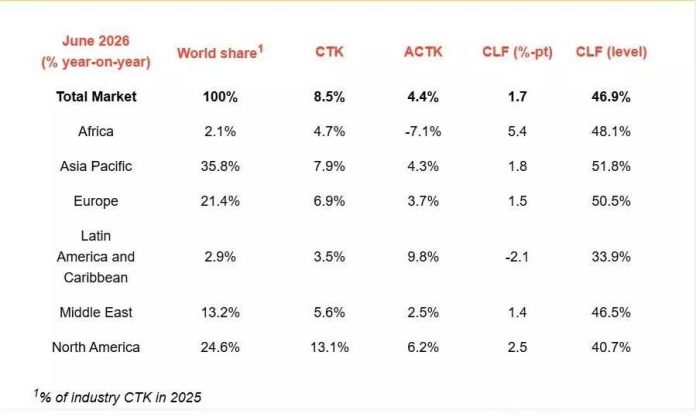
Total air cargo demand, measured in cargo tonne-kilometers (CTK), rose by 8.5% year-on-year, while international demand increased by an even stronger 9.6%. In comparison, available cargo capacity (ACTK) grew at a slower pace of 4.4%, with international capacity up 4.9%. The figures highlight a sustained imbalance, with demand expanding faster than supply across the global market.
IATA Director General Willie Walsh noted that all regions recorded positive demand growth compared to the previous year, with North America leading performance. He added that, with the exception of Latin America and the Caribbean, most regions saw demand outpace capacity growth during the month.
Air cargo demand also continued to grow faster than global trade, supported by strong shipments of high-value technology goods and time-sensitive cargo. This trend underpins a broadly positive outlook for the second half of 2026. However, the industry still faces risks, including geopolitical tensions in the Middle East and renewed tariff concerns in the United States, which could impact future demand.
Global trade expanded by 5.2% year-on-year, providing a solid foundation for air cargo growth. Jet fuel prices fell by 20% month-on-month in June, although they remained 45.8% higher than the same period last year. Meanwhile, global manufacturing activity softened slightly but remained in expansion territory. The Global Manufacturing Output PMI edged down by 0.5 points to 53.0, while the New Export Orders Index stayed below the 50 mark for a fourth consecutive month at 49.4. This suggests that recent cargo growth is being driven more by specific trade lanes and high-demand commodities rather than a broad-based export recovery.
Regional performance remained positive overall, though growth rates varied. Asia-Pacific airlines reported a 7.9% increase in cargo demand alongside a 4.3% rise in capacity. North American carriers delivered the strongest results, with demand surging 13.1% and capacity up 6.2%. European airlines saw demand grow by 6.9%, supported by a 3.7% increase in capacity.
In the Middle East, carriers recorded a 5.6% rise in demand and a 2.5% increase in capacity, although growth comparisons were influenced by disruption in June 2025 due to regional conflict. Latin American and Caribbean airlines posted the slowest demand growth at 3.5%, while capacity expanded sharply by 9.8%. African carriers achieved a 4.7% increase in demand despite a 7.1% decline in available capacity.
Overall, June’s figures confirm continued resilience in the air cargo sector, with demand fundamentals remaining strong despite ongoing economic and geopolitical uncertainties.