

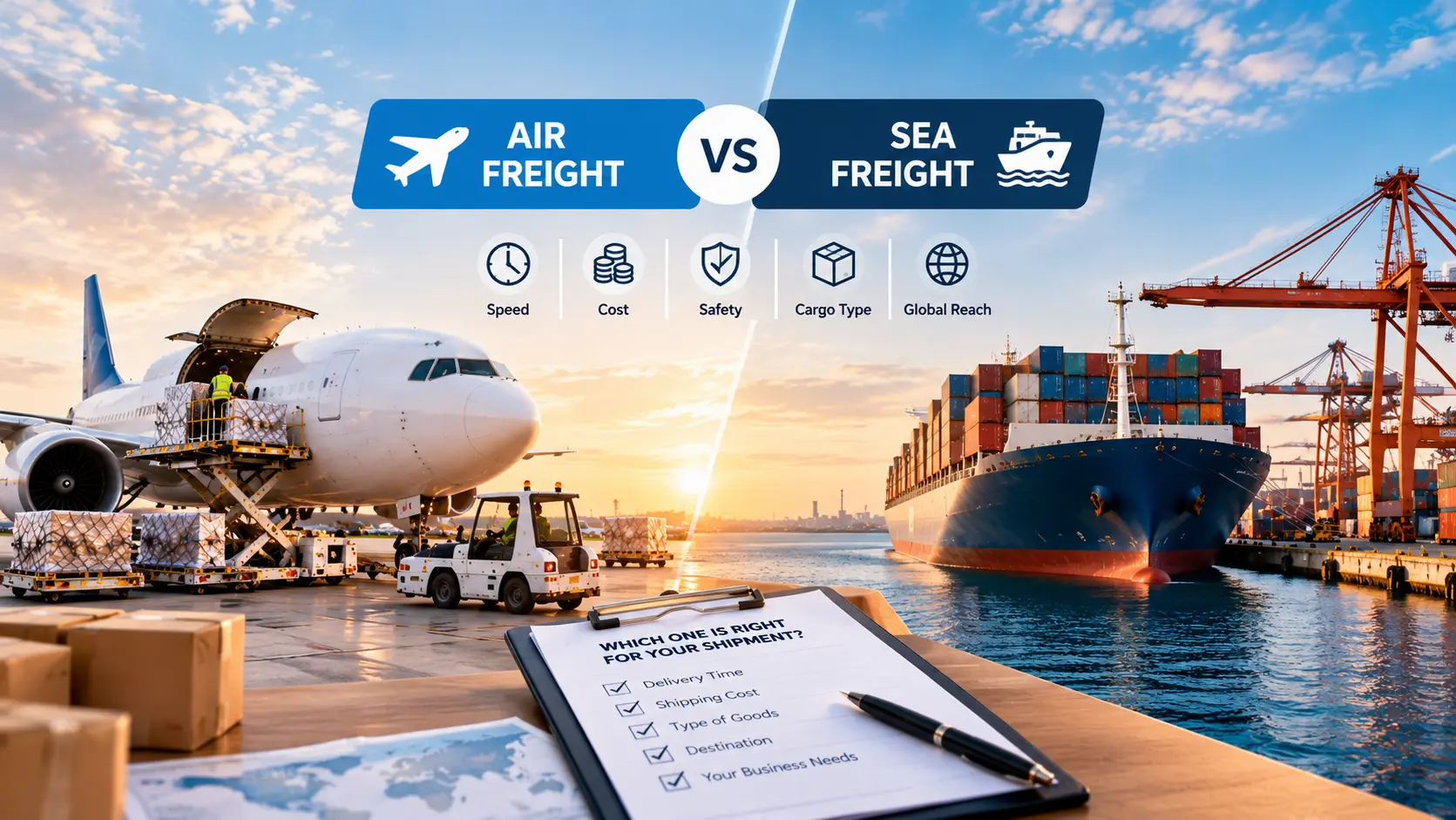
Sea freight is cheaper for heavy, bulky and non-urgent cargo. Air freight is faster and usually cheaper in total for light, dense, high-value or time-critical cargo. The point where the two cross over depends on the weight and volume of the specific shipment, not on a general rule.
Most comparisons stop at speed against cost and leave the reader to guess. The more useful question is where the line sits for a particular consignment, and that is something a shipper can calculate rather than estimate.
This page covers how the two modes are priced, how to find that crossover, what the waiting actually costs, and what the current emissions standard says about the difference between them.
What Is the Difference Between Air Freight and Sea Freight?
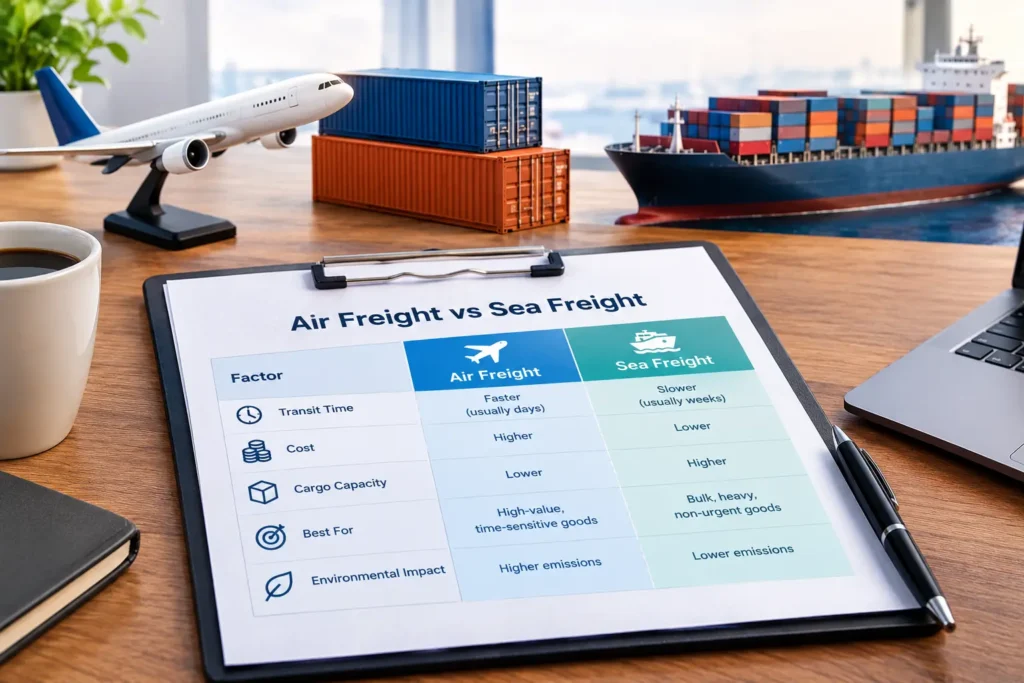
Air freight moves cargo in aircraft and is priced on chargeable weight. Sea freight moves cargo in vessels and is priced by container or by volume, depending on whether the shipment fills a container.
The table below sets out how the two modes differ across the factors that decide most shipping decisions.
| Factor | Air freight | Sea freight |
|---|---|---|
| Priced on | Chargeable weight, the higher of actual and volumetric | Full container, or volume against weight for part loads |
| Typical Asia to Europe transit | Days | Weeks |
| Best suited to | Light, dense, high-value, perishable or urgent cargo | Heavy, bulky, low-value and non-urgent cargo |
| Schedule reliability | Higher, with faster recovery from disruption | Lower, exposed to port congestion and weather |
| Capacity constraint | Weight and aircraft hold dimensions | Volume and container dimensions |
| Emissions per tonne-km | Roughly 545 to 1,516 g CO2e depending on service | Roughly 10 to 20 g CO2e for deep-sea container |
| Minimum practical shipment | Small, a single carton is viable | Larger, though part loads exist |
The pattern across the table is that air freight wins on time and certainty while sea freight wins on cost per unit of volume. The decision is about which of those matters more for the cargo in question, and about where the cost lines actually cross.
Why Can You Not Compare an Air Rate and a Sea Rate Directly?
The two modes are priced on different bases, so a rate per kilogram and a rate per container describe different things and cannot be set side by side without converting both to a cost for the same shipment.
Air freight is quoted per kilogram of chargeable weight, which is the higher of actual gross weight and volumetric weight. Volumetric weight is calculated by dividing the shipment’s volume in cubic centimetres by 6000, so anything lighter than roughly 167 kilograms per cubic metre is charged on its size rather than its weight.
Cargo built onto a unit load device is measured as presented, including the pallet base and any overhang, which adds volume without adding payload.
Sea freight is quoted two ways. A full container load is priced as a flat rate for the container regardless of how full it is. A part load is priced on whichever is greater, the volume in cubic metres or the weight in tonnes, at a rate per unit.
The consequence is that the same consignment can look cheap by one measure and expensive by the other. A light, bulky shipment is punished by air pricing and barely noticed by full container pricing. A dense, heavy shipment is the opposite.
To compare properly, work out the total door-to-door cost for the specific shipment under both, including surcharges and local charges at both ends. The components of an air quote are set out in the guide to air freight rates.
How Do You Find the Crossover Point for Your Shipment?
The crossover point is the shipment size at which total air freight cost stops exceeding total sea freight cost, and it is found by calculating both totals for the actual consignment rather than by applying a rule of thumb.
Work through these five steps.
- Measure and weigh accurately. Take the gross weight in kilograms and the external dimensions of every piece, including pallets and packaging.
- Calculate the air chargeable weight. Divide the total volume in cubic centimetres by 6000 and compare it against the gross weight. The higher figure is what air freight bills on.
- Build the all-in air cost. Rate per kilogram times chargeable weight, plus fuel and security surcharges, terminal handling at both ends, collection, delivery and customs.
- Build the all-in sea cost. Container or part-load rate, plus terminal handling at both ports, documentation, collection, delivery, customs and any demurrage risk.
- Add the cost of the extra time. Covered in the next section. This is the step most comparisons miss entirely.
The crossover moves with the cargo. Dense cargo crosses over at a lower weight, because air pricing treats it kindly. Bulky cargo crosses over at a higher weight or not at all, because air pricing charges it on volume while a full container does not care.
Where Does the Crossover Usually Sit?
The crossover sits lower for dense, high-value cargo and higher for bulky, low-value cargo, which is why no single weight threshold works across shipments.
Three factors move it.
- Density. The closer a shipment sits to 167 kilograms per cubic metre, the more neutral air pricing becomes. Below that, air pricing penalises the volume.
- Value. High-value cargo carries more capital in transit and more insurance exposure, which pushes the crossover down.
- Market conditions. Air rates and ocean rates move independently. A disrupted ocean market narrows the gap sharply, which is why cargo shifts to air during port congestion.
What Does the Extra Transit Time Actually Cost?
Time in transit carries a real cost, made up of capital tied up in stock that is moving rather than selling, the safety stock held to cover schedule variability, and the risk of missing a sales window.
Four costs sit behind the waiting.
- Carrying cost of inventory. Cargo in transit is money that cannot be used elsewhere. Thirty days at sea on a high-value consignment ties up working capital for a month.
- Safety stock. Longer and less predictable transit forces higher buffer stock at destination, which carries its own warehousing and capital cost.
- Obsolescence and seasonality. Fashion, electronics and anything with a short commercial life can lose value faster than the freight saving is worth.
- Shelf life. Perishables and pharmaceuticals have a fixed window, and transit time consumes it.
A shipper comparing a sea quote against an air quote on freight cost alone is comparing the two most visible numbers while ignoring the one that often decides the answer. Adding an estimated carrying cost for the additional transit days changes the comparison, and sometimes reverses it.
Which Is Faster and More Reliable?
Air freight is faster by a wide margin and recovers from disruption more quickly, while sea freight schedules are exposed to port congestion, weather and vessel bunching.
Speed is the obvious difference. Reliability is the one that costs money quietly.
- When an air shipment is delayed, the next flight is usually hours or a day away
- When a vessel is delayed, the next sailing may be a week away, and congestion at the destination port adds further time after arrival
- Variability matters as much as the average, because planning is built on the worst case rather than the typical case
This is why some shippers pay for air on lanes where the average sea transit would be acceptable. They are buying predictability, not speed.
When Should You Use Air Freight?
Air freight suits cargo where speed, shelf life, value density or schedule certainty outweighs the higher freight cost.
Use air for:
- Time-critical shipments, including production-stopping parts and launch deadlines
- Live animals, which have no practical sea alternative
- High-value, low-weight goods such as electronics, components and precision instruments
- Pharmaceutical and temperature sensitive cargo, where transit time consumes product stability and the cold chain has to hold throughout
- Perishables including fresh produce, seafood and flowers
- Seasonal goods where the sales window is fixed
- Samples, documents and small urgent consignments
- Cargo moving to a market with limited or unreliable port access
When Should You Use Sea Freight?
Sea freight suits cargo where volume or weight is high, the value per kilogram is low, and the delivery date allows weeks rather than days.
Use sea for:
- Bulk commodities and raw materials
- Furniture, appliances and other large, low-density goods
- Machinery and heavy equipment
- Regular replenishment where lead time is planned into the cycle
- Anything where the freight cost would be a large proportion of the goods value by air
Is There an Option Between the Two?
Sea-air routings combine an ocean leg to an intermediate hub with an air leg onward, giving transit times shorter than full ocean and costs lower than full air.
Cargo moves by vessel to a transhipment hub, then transfers to aircraft for the remaining distance. Hubs in the Middle East and South Asia handle most of this traffic, because they sit between major manufacturing origins and the main consuming markets.
Sea-air works when the date is too close for full ocean but the budget will not carry full air, and it needs a forwarder experienced in the specific corridor, since the handover between modes is where the time saving is won or lost. Discuss it with a freight forwarder before assuming the choice is binary.
How Much Worse Is Air Freight for Emissions?
Air freight is considerably more carbon-intensive than sea freight per tonne-kilometre, and the gap is wider than most comparisons state because air intensity varies substantially by service type.
The current standard for calculating transport emissions is the GLEC Framework, which is aligned to ISO 14083. Under it, intensity figures differ sharply across air services.
| Mode and service | Approximate intensity, g CO2e per tonne-km |
|---|---|
| Deep-sea container ship | 10 to 20 |
| Air, long-haul belly cargo | Around 545 |
| Air, short-haul dedicated freighter | Around 1,516 |
Read against each other, the multiple runs from roughly 25 times for long-haul belly cargo up to well over 100 times for short-haul freighter traffic. The widely repeated figure of 47 times describes one comparison, not the range.
The practical point is that the service matters, not only the mode. Cargo in the hold of a scheduled passenger flight carries a very different footprint from the same cargo on a short-haul freighter, and a shipper reporting emissions under ISO 14083 needs the right factor for the service actually used rather than a single generic air number.
Questions About Air Freight and Sea Freight
Is air freight cheaper than sea freight?
No, not on freight cost for most shipments. Sea freight is substantially cheaper per unit of volume or weight. Air freight can be cheaper in total for small, dense, high-value consignments once handling, insurance and the cost of extra transit time are included.
Which is faster, air freight or sea freight?
Air freight, by a wide margin. Air transit on major intercontinental lanes is measured in days and sea transit in weeks. Air freight also recovers from disruption faster, because the next departure is usually hours away rather than days.
What are the downsides of air freight?
Higher freight cost, strict limits on weight and dimensions, pricing that penalises low-density cargo, and much higher carbon intensity per tonne-kilometre. Some cargo is also restricted or prohibited in air transport under dangerous goods rules.
How much cheaper is sea freight than air freight?
The difference varies by lane, season and market conditions rather than following a fixed ratio. A meaningful comparison requires calculating the all-in door-to-door cost of the specific shipment under both modes, including surcharges, local charges and the carrying cost of the additional transit time.
Can you combine air and sea freight?
Yes. Sea-air routings move cargo by vessel to an intermediate hub and by aircraft for the remaining leg, producing transit times shorter than full ocean and costs below full air. Most of this traffic runs through hubs in the Middle East and South Asia.
Does volumetric weight apply to sea freight?
A version of it does. Part-load sea freight is charged on whichever is greater, the volume in cubic metres or the weight in tonnes. Full container load pricing is a flat rate for the container, so neither weight nor volume affects it until the container is full.
Which mode should I use for pharmaceuticals?
Air freight in most cases, because transit time consumes product stability and the cold chain is harder to hold for weeks than for days. Temperature controlled sea freight exists and is used for some products, though the qualification requirements are more demanding.