
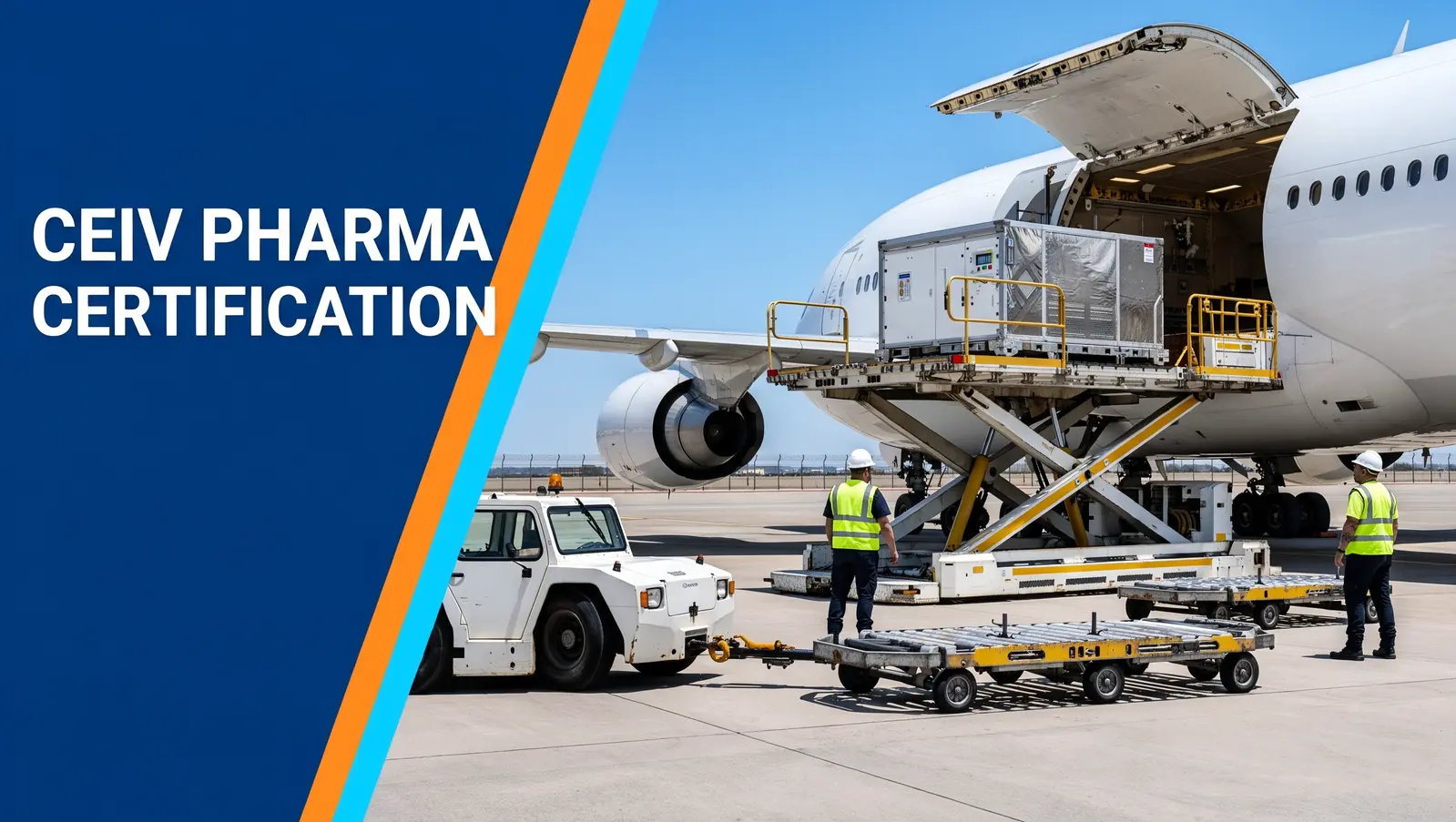
CEIV Pharma is IATA’s certification for handling pharmaceutical air cargo. Carriers, forwarders, ground handlers and airports hold it, and most of them mention it on the first page of their website.
Fewer of them mention which of their stations it covers. This page explains what the certification assesses, how long it lasts, what it does not promise, and the questions worth asking before you book a consignment on the strength of it.
What Is CEIV Pharma Certification?
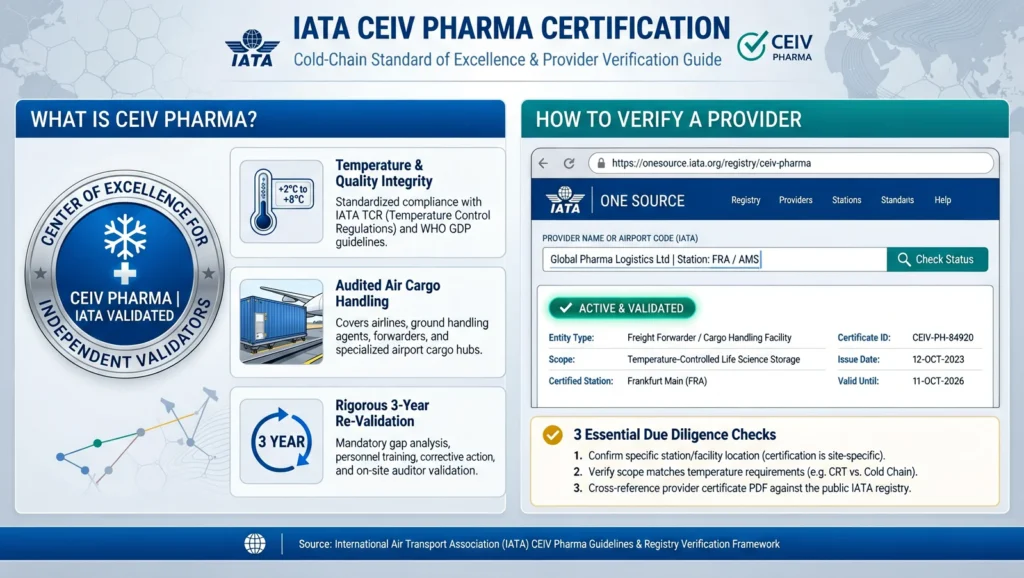
CEIV Pharma is a certification programme run by IATA covering the handling of temperature-sensitive pharmaceutical air cargo. It assesses facilities, equipment, processes and staff against international standards, and it is awarded after an on-site audit rather than a paper exercise.
IATA describes it as a GDP-plus certification, meaning it takes Good Distribution Practice as its base and adds air cargo specific requirements on top.
The purpose is consistency. Pharmaceutical shipments pass through several hands between manufacturer and patient, and each handover is a point where temperature control can fail. CEIV exists so that a shipper can expect comparable handling at every certified point rather than assessing each one individually.
What Standards Is CEIV Pharma Built On?
Five, combined into one assessment. The certification does not create a new standard so much as pull the existing ones into a single auditable framework.
| Standard | What it contributes |
|---|---|
| Good Distribution Practice (GDP) | National and EU guidelines on distributing medicinal products |
| WHO Annex 5 | World Health Organization guidance on time and temperature sensitive products |
| IATA Temperature Control Regulations | The air cargo operational requirements |
| IATA Chapter 17 | Perishable cargo handling provisions for pharmaceuticals |
| USP and local regulation | United States Pharmacopeia requirements and applicable national rules |
GDP is the one most shippers will already know, because it governs the pharmaceutical supply chain generally. What CEIV adds is the air cargo layer, covering apron handling, tarmac exposure, ULD selection and the parts of the journey GDP was not written for.
For how temperature control actually works in the air, see temperature controlled air freight.
Who Can Be Certified?
Four kinds of organisation. Airlines, freight forwarders, ground handlers and airports.
Airports are the interesting case. An airport achieving CEIV status generally means that its cargo community has certified together, which creates what the industry calls a pharma corridor, a route where every handover point between two airports is certified.
That is the strongest version of the certification from a shipper’s perspective. A certified forwarder at one end of a lane is useful. A certified chain along the whole lane is considerably more useful, because the risk sits at the handovers rather than inside any single facility.
How Does the Certification Process Work?
Five stages, with the assessment work done on site rather than remotely.
- Off-site documentation review. IATA assessors examine procedures, quality management records and training documentation
- On-site gap analysis. Assessors visit the facility and compare actual practice against the standards
- On-site validation. A deeper review of processes, equipment and personnel competence
- Gap closure. The organisation addresses the findings, which is usually the longest part
- Findings and recommendations. A report issues, and certification follows once gaps are closed
The assessment covers the facility, the equipment, the written processes and the people. Training and personnel status are examined specifically, which is why certification is harder to maintain through staff turnover than organisations expect.
Most of the elapsed time sits in stage four. The audit is quick, and bringing a facility up to the standard it exposed is not.
How Long Does CEIV Pharma Certification Last?
Published operator accounts describe a three year cycle, with a recertification audit before the certificate expires.
Operators who have been through it consistently advise preparing months ahead rather than weeks, and treating recertification as a continuous process rather than a periodic event. The common failure is a facility that met the standard at audit and drifted afterwards.
For a shipper this matters in one specific way. A certification held three years ago is not a certification held now. Ask for the current certificate and its date, not a logo on a website.
Is CEIV Pharma Awarded Per Company or Per Facility?
Per assessed facility and operation, which is the detail most often lost when the certification is marketed.
The audit is physical. Assessors examine a building, its equipment, its procedures and its staff. What results is certification of what was assessed, not a badge covering everything the parent company does worldwide.
This has a direct consequence. A global forwarder with forty stations may hold CEIV Pharma at four of them. The claim on the website is accurate. Whether it applies to the station handling your shipment is a separate question, and it is the question to ask.
The same applies along a route. A certified origin station and an uncertified destination station produce a chain that is only as controlled as its weakest handover, which is why airport-level certification and pharma corridors carry more weight than a single certified party.
Ask which stations are covered on your specific lane. A freight forwarder that handles pharmaceutical traffic will have that answer ready.
What Does CEIV Pharma Not Guarantee?
It certifies capability, not outcomes. This is the second thing most often misread.
Three limits are worth being clear about.
- It does not prevent excursions. A certified facility has the processes, equipment and trained staff to control temperature, and controlled is not the same as guaranteed. Equipment fails and flights divert
- It does not change liability. Carrier liability for cargo is governed by international convention and by the contract of carriage. Certification does not alter either
- It does not cover the whole journey. It covers the certified facilities and operations. The road leg, the uncertified transshipment point and the consignee’s own receiving dock are outside it
What certification does is reduce the probability of failure and make the handling auditable when something goes wrong. That is genuinely valuable. It is not a warranty, and a shipper relying on it as one has no fallback when an excursion happens.
Keep your own temperature monitoring regardless of who is certified. The data record is what resolves a claim, as covered in pharmaceutical air freight.
How Do You Check a Provider’s Certification?
Six questions, and all of them should get an immediate answer from a provider that genuinely holds it.
- Which specific stations are certified, and is my origin and destination among them?
- What is the certificate date and when is recertification due?
- Can I see the current certificate rather than the logo?
- Which parts of my lane are not covered, and who handles those?
- What temperature monitoring is applied, and do I receive the data?
- What is the excursion procedure, and at what point am I told?
Question four is the one that reveals most. A provider that answers it openly is describing a real chain. A provider that treats the question as hostile is selling a badge.
Question six matters because notification timing decides whether a consignment can be recovered. An excursion reported on arrival is an insurance claim. An excursion reported in transit is sometimes a product that can still be saved.
Does Your Shipment Need a CEIV Certified Partner?
It depends on the product and on what your own quality requirements say, rather than on the value of the consignment.
Licensed medicinal products moving under GDP obligations generally need a partner who can evidence compliant handling, and CEIV is the clearest way to evidence it in air cargo. Clinical trial material and biologics usually sit in the same category.
Products that are temperature sensitive without being regulated medicinal products are a judgement call. Cosmetics, some nutraceuticals and certain food products need good cold chain handling without needing pharmaceutical certification behind it.
The honest position is that CEIV is a strong signal rather than a requirement in itself. Your own quality agreement is what creates the obligation. Check what that document requires before paying for certification you do not need, and before assuming a certified partner satisfies a requirement it does not actually address.
For how the handling itself works once a booking is made, see air cargo handling. Terms used on this page are defined in the air cargo glossary.
Questions About CEIV Pharma Certification
What is CEIV Pharma certification?
An IATA certification covering the handling of temperature-sensitive pharmaceutical air cargo. It assesses facilities, equipment, processes and staff against GDP and air cargo standards, awarded after an on-site audit.
What is the difference between GDP and CEIV Pharma?
GDP is the general standard for distributing medicinal products. CEIV Pharma takes GDP as its base and adds air cargo specific requirements, which is why IATA describes it as GDP-plus.
How long is CEIV Pharma certification valid?
Published operator accounts describe a three year cycle with a recertification audit before expiry. Ask any provider for the certificate date rather than relying on a logo.
Is CEIV Pharma certification company-wide?
No. It is awarded against the facilities and operations assessed. A company may hold it at some stations and not others, so confirm it covers the stations handling your lane.
Does CEIV Pharma guarantee my shipment will not have a temperature excursion?
No. It certifies that a facility has the capability, processes and trained staff to control temperature. It does not prevent equipment failure or diversions, and it does not change carrier liability.
Who can hold CEIV Pharma certification?
Airlines, freight forwarders, ground handlers and airports. Where an airport community certifies collectively the result is a pharma corridor, where every handover point along a route is certified.