


A ULD code is not a product name. It is a structured identifier, and once the structure is clear, a code you have never seen before tells you what the unit is, what shape it is, where it fits on an aircraft and who owns it.
Most reference pages hand over a list of codes to memorise. This one shows the method, so the list becomes unnecessary.
What Is a ULD Code?
A ULD code is the identifier marked on every unit load device, made up of a three-letter prefix, a serial number and an owner code. The prefix states the category, base size and contour. The format is set by IATA Resolution 686 and the detailed rules sit in Section 4 of the ULD Regulations.
The full identifier runs to nine or ten characters. It is written in three blocks, which is why a code on a real unit looks like AKE 12345 ZZ rather than a single unbroken string.
Every unit in service carries one. It is how an airline tracks a container across a network, how a handler confirms the right unit was loaded and how a billing system knows whose asset is sitting on whose apron.
Why Does a ULD Need a Code at All?
A ULD is a removable aircraft part, not packaging. The code is the link between the physical unit and the aircraft loading data that governs where it is allowed to sit.
Load control systems reference the base size and contour from the code when building a loading instruction. Get the marking wrong and the aircraft weight and balance calculation is working from the wrong unit. That is the reason the marking rules are strict and the reason re-marking a unit without the owner’s approval is never permitted.
How Do You Read a ULD Code?
Read it in three blocks, left to right. The first three letters describe the unit, the middle digits identify the individual asset, and the last two characters name the owner.
Work through them in order and each block answers a different question. What is it, which one is it, and whose is it.
The three tables below cover the first block, which carries all the technical meaning. A definition of each position comes first, then the letters.
What Does the First Letter of a ULD Code Mean?
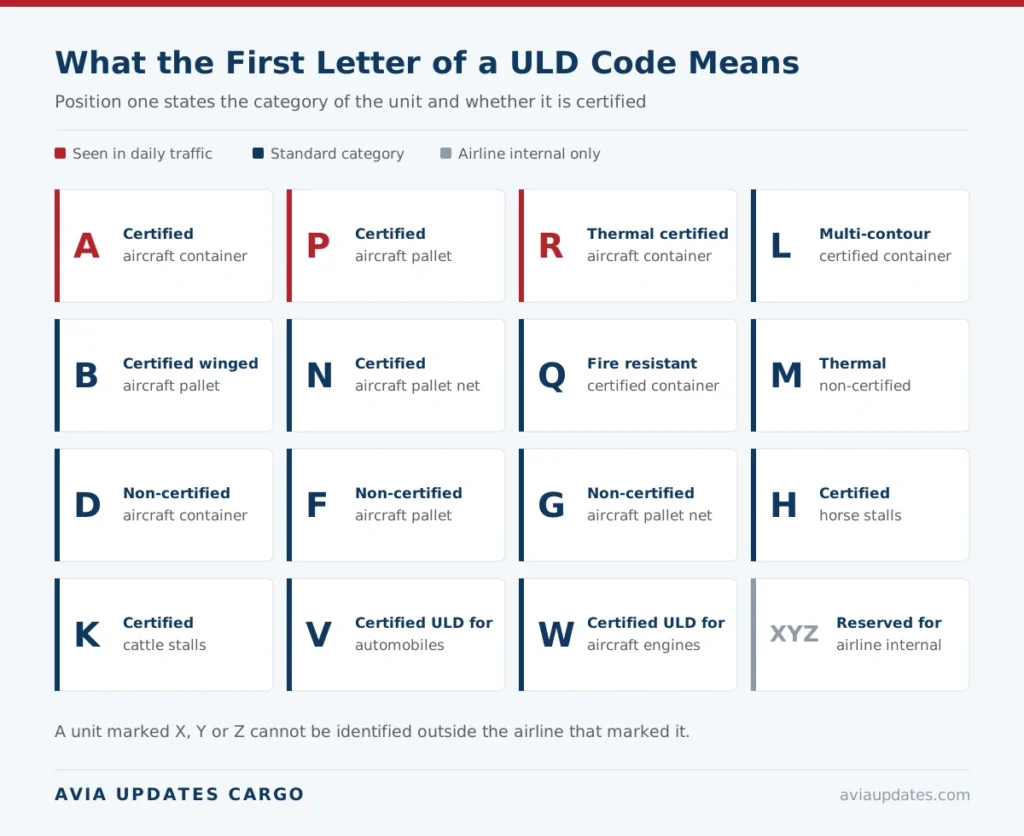
The first letter states the category of the unit, covering whether it is a container, a pallet or a net, and whether it is certified. Certified units are designed and tested to TSO C90 and approved by a civil aviation authority. Non-certified units are not.
These are the categories in general use.
| Letter | Category |
|---|---|
| A | Certified aircraft container |
| B | Certified winged aircraft pallet |
| D | Non-certified aircraft container |
| F | Non-certified aircraft pallet |
| G | Non-certified aircraft pallet net |
| H | Certified horse stalls |
| K | Certified cattle stalls |
| L | Certified multi-contour aircraft container |
| M | Thermal non-certified aircraft container |
| N | Certified aircraft pallet net |
| P | Certified aircraft pallet |
| Q | Certified fire resistant container |
| R | Thermal certified aircraft container |
| V | Certified ULD for automobile transport |
| W | Certified ULD for aircraft engine transport |
| X, Y, Z | Reserved for airline internal use |
A unit starting with X, Y or Z cannot be identified by anyone outside the airline that marked it. Those three letters sit outside the shared system by design.
The letters that matter most in daily traffic are A for certified containers, P for certified pallets and R for thermal certified containers. A unit starting with R is the one carrying temperature controlled air freight, and a unit starting with H or K is carrying animals under live animals air transport regulations.
What Does the Second Letter Mean?
The second letter states the base dimensions of the unit, drawn from a set of standard base sizes. Aircraft weight and balance manuals reference these codes directly, which is why an incorrect second letter is an operational problem rather than a clerical one.
Common base letters include K for the base used by the familiar half-width lower-deck container, A and B for full-width main-deck pallet bases, M for the ten-foot base, R for the sixteen-foot base and G for the twenty-foot base.
Two exceptions are worth knowing. Units marked before 1984 may carry a number in this position rather than a letter. And X, Y or Z here means a non-standard base, useful only inside the airline operating it.
What Does the Third Letter Mean?
The third letter means different things for containers and for pallets. On a container it states the contour, which is the shape of the unit. On a pallet it states the certification, which determines which loading systems the unit works with.
Contour is the reason a container fits one aircraft hold and not another. The shape is cut to the curve of the fuselage, so a unit with the wrong contour for the aircraft does not go in, whatever its base size says.
On pallets the distinction is less visible and more dangerous. PAG and PAJ are the same base size and look close to identical on an apron, but the certification differs, and the aircraft weight and balance manual is the only place to confirm which one a given position accepts. Air cargo handling teams check this at build-up rather than at the aircraft.
What Do the Numbers in a ULD Code Mean?
The four or five characters after the prefix are the serial number, assigned by the owner to identify that individual unit. They carry no technical meaning about the unit’s shape or capability.
Most units use five characters. The earlier system allowed only four, so both lengths remain in circulation. The first character of the block can be a letter rather than a numeral, which is why a valid code may read B 1234 as well as 12345.
One change is worth watching. There is an early-stage proposal to use a letter in that first serial position to flag a feature of the unit, such as lightweight construction or a metal door. It is not in general use, so a letter there today usually means nothing more than the owner’s own numbering choice.
What Do the Last Two Characters Mean?
The final two characters are the owner code, assigned by IATA’s Code Administration Coordinator. They identify the airline or the non-airline owner of the unit, which matters because ULDs move between carriers constantly and someone has to be billed.
Two characters is the standard. Three-character owner codes appear often enough to be a recognised error, and the consequence is specific. A system built to accept two characters will drop one, and the result is a different identifier pointing at a different unit.
When a unit transfers between airlines, the movement is recorded on a ULD Control Receipt. Transfer data moves between carriers as a LUC message, and a MUC message records the same transfer into the industry tracking system. The owner code is the key those records are built on.
Why Is the Same Container Called Both AKE and LD3?
Because two naming systems are in use. AKE is the IATA identification code, built from the three-letter prefix described above. LD3 is an older ATA code, written as two letters and a number, and it stayed in circulation after the IATA system replaced it.
Both names describe the same physical unit. Appendix D of the ULD Regulations holds the cross-reference table between them.
In practice airlines, handlers and loading systems use the IATA code because it is the one carrying the technical data. Forwarders, shippers and sales conversations often still use the ATA code because it is shorter and older. A quote mentioning LD3 and a loading instruction mentioning AKE are not describing different equipment.
Which ULD Codes Come Up Most Often?
A small number of codes account for most of the units a shipper encounters. The table below gives the code, what the prefix decodes to and where the unit is normally used.
| Code | What the prefix means | Normally used for |
|---|---|---|
| AKE | Certified container, standard half-width base, lower-deck contour | General lower-hold cargo on wide-body aircraft |
| AVE | Certified container, same base, alternative contour | Same role as AKE on different aircraft types |
| LD3 | ATA name for the AKE and AVE family | Used interchangeably in quotes and bookings |
| PAG | Certified pallet, standard base, one certification type | Main-deck and lower-deck palletised cargo |
| PAJ | Certified pallet, same base, different certification | Positions where PAG certification does not apply |
| PMC | Certified pallet, ten-foot base | High-volume palletised freight |
| PQP | Certified pallet, ten-foot base, alternative specification | Freighter main-deck loading |
| PGE | Certified pallet, twenty-foot base | Long or oversized consignments on freighters |
| RKN | Thermal certified container | Active temperature controlled pharmaceutical shipments |
Exact internal dimensions, tare weights and maximum gross weights for each code sit in the operator’s own specification and vary by build. Confirm those with the carrier rather than from a general reference, because they feed directly into the chargeable weight calculation and into the air freight rates you are quoted.
What Goes Wrong When a ULD Code Is Wrong?
An incorrect code produces an incorrect loading decision. The code is the input to weight and balance planning, so an error in the marking becomes an error in the aircraft load plan rather than an error in a document.
Three failures account for most of it.
- Wrong contour. The unit reaches the aircraft and does not fit the hold, so the shipment offloads and rebooks
- Wrong base size. Load control plans a position the unit cannot physically occupy, found at the aircraft rather than at build-up
- Truncated owner code. The unit is tracked against the wrong owner, so the transfer record and the billing both fail
There is also a condition check that sits alongside the code. Every certified unit carries an Operational Damage Limits Notice, which states how much damage the unit can take before it must come out of service, and a TSO plate confirming the certification standard it was built to. A valid code on a damaged unit is still an unserviceable unit.
How Does a Shipper Use ULD Codes When Booking?
Use the code to confirm the unit matches the cargo before the booking is accepted, not after. Three checks cover almost every case.
Check the first letter against what you are shipping. Pharmaceutical cargo needs R, not A. Animals need H or K. General cargo takes A or P.
Check the code appears on the booking confirmation and matches what arrives at build-up. The unit standing on the apron and the unit named in the booking should carry the same prefix.
Check the owner code is two characters. If a system has recorded three, the record is pointing somewhere other than the unit you booked.
The code itself does not appear on the air waybill, which describes the consignment rather than the equipment. It appears on the loading documentation, and your forwarder can supply it on request.
For the wider picture on how containers and pallets work as a system, including who owns them and who is liable for damage, see ULD air cargo containers.
Questions About ULD Codes
What does AKE stand for?
AKE is not an abbreviation of words. It is a three-position code where A means certified aircraft container, K means the standard half-width base size and E identifies the contour. The same unit is also known by its older ATA name, LD3.
How many characters are in a ULD code?
Nine or ten. Three for the prefix, four or five for the serial number and two for the owner code. Both serial lengths remain valid because the earlier system allowed four characters and the current one allows five.
What is the difference between an IATA ULD code and an ATA code?
An IATA code is three letters, such as AKE. An ATA code is two letters and a number, such as LD3. They name the same equipment under two systems, and Appendix D of the ULD Regulations cross-references them.
Can a ULD be re-marked with a different code?
Not without the owner’s approval. The code ties the unit to its certification and its ownership record, so re-marking without authorisation breaks both the tracking chain and the loading data the code feeds.
What does a ULD code starting with X, Y or Z mean?
Those letters are reserved for airline internal use, in both the category position and the base size position. A unit marked that way can only be identified by the airline that marked it, which is why they do not appear in general traffic.
Where are the official ULD code rules published?
In the IATA ULD Regulations. Section 4 holds the identification rules and Appendix D holds the ATA cross-reference. The underlying format comes from IATA Resolution 686.