


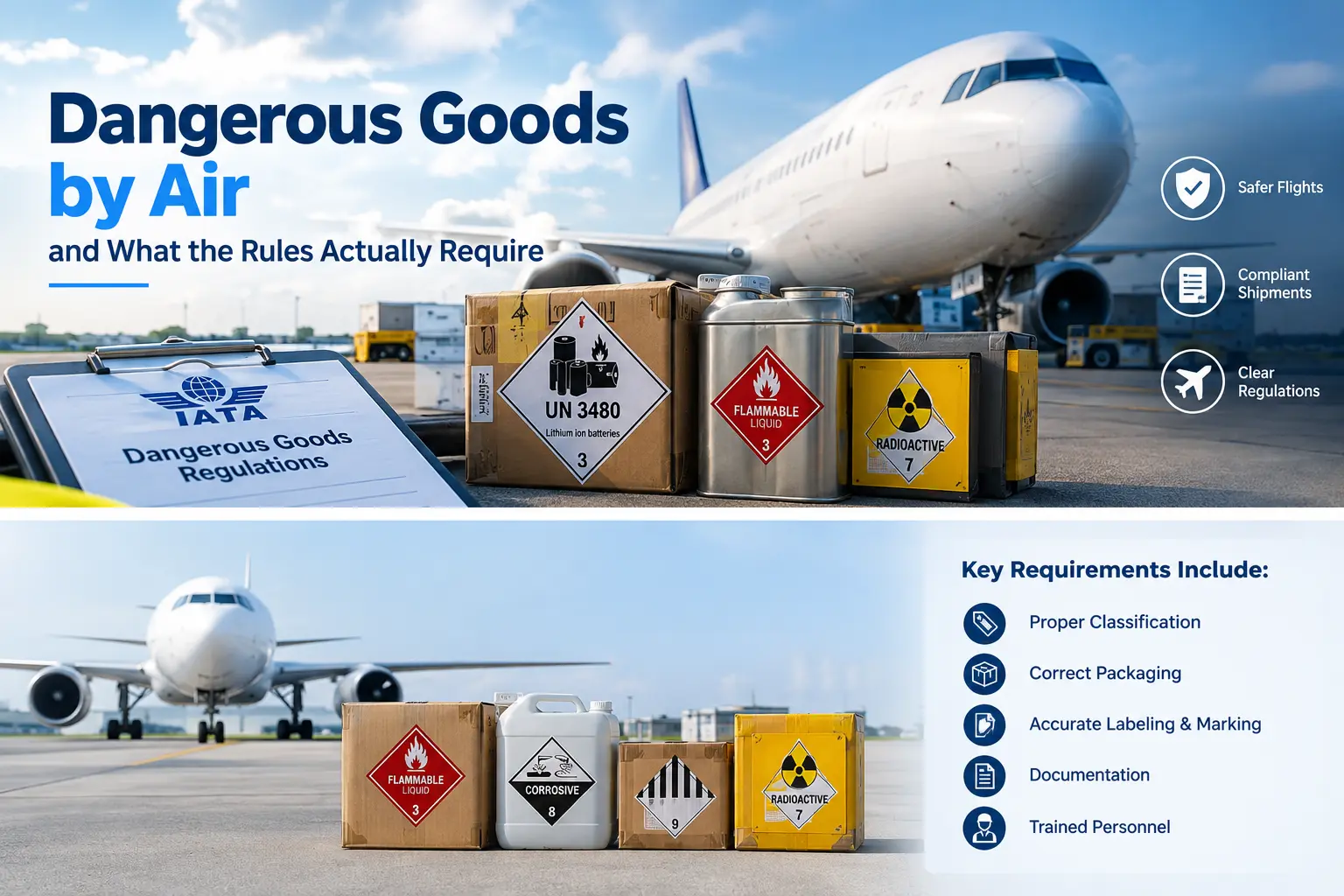
Dangerous goods are substances and articles capable of posing a risk to health, safety, property or the environment in transport, and moving them by air requires classification, approved packaging, specific marking and labelling, a signed declaration, and personnel trained within the previous 24 months.
Nine hazard classes cover everything from explosives to lithium batteries. Each carries its own packing instructions, quantity limits and handling rules, and some substances are forbidden on aircraft entirely.
The part shippers most often misunderstand is which document is binding. The manual the industry works from day to day is not the legal instrument, and the rules that stop a shipment are frequently not in the manual at all.
Who Governs the Transport of Dangerous Goods by Air?
Four layers of rules apply, and a shipment has to satisfy all of them rather than just the first.
| Layer | What it is | Status |
|---|---|---|
| ICAO Technical Instructions, Doc 9284 | The international technical standard for dangerous goods by air | Legally binding on ICAO member states under the Chicago Convention |
| IATA Dangerous Goods Regulations | The operational manual, incorporating the ICAO Instructions in a working format with additional industry requirements | Industry standard, not law in itself, and in places stricter than ICAO |
| State variations | Additional or differing requirements imposed by individual countries | Binding in the states that impose them |
| Operator variations | Additional requirements imposed by individual airlines | Binding on shipments carried by that airline |
The practical consequence is that a shipment can satisfy the ICAO Instructions, satisfy the IATA manual, and still be refused because the airline carrying it imposes a stricter rule, or because the country of origin, transit or destination does.
Variations are published in the DGR itself, and checking them for the specific routing and the specific carrier is part of preparing the shipment rather than an optional extra. This is the single most common gap between a shipper who thinks the consignment is compliant and a handler who refuses it.
Which Edition Applies?
The IATA Dangerous Goods Regulations are republished annually and the current edition is the 67th, effective from 1 January 2026.
Editions matter because requirements change between them. The 2026 edition introduced a state of charge limit of 30 percent for lithium ion batteries packed with equipment under Packing Instruction 966, and added new entries covering hybrid battery-powered vehicles. Working from a superseded edition is a recognised cause of rejected shipments.
What Are the Nine Classes of Dangerous Goods?
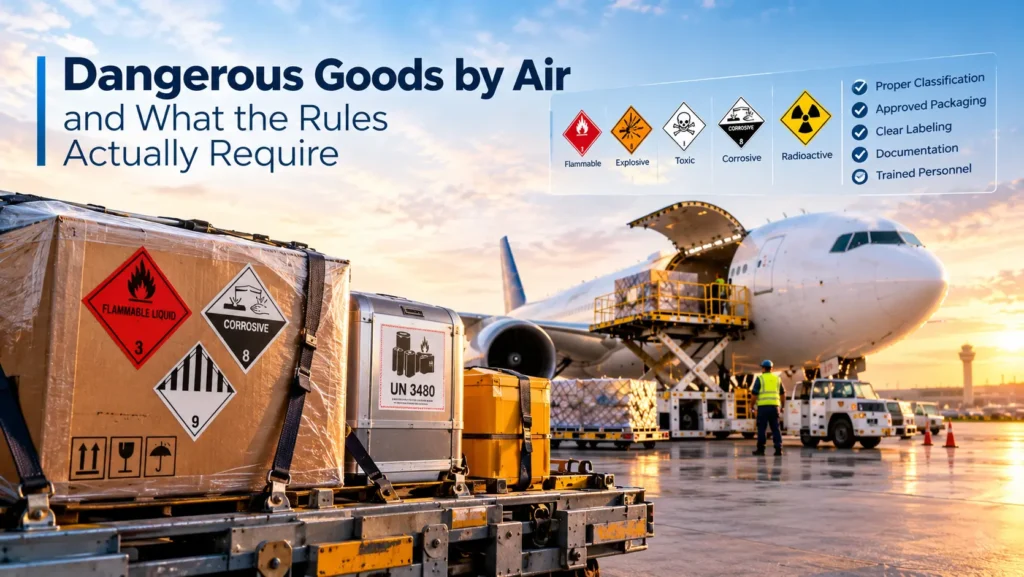
Dangerous goods are divided into nine United Nations hazard classes, assigned by the nature of the risk rather than by what the product is used for.
| Class | Hazard | Examples |
|---|---|---|
| 1 | Explosives | Fireworks, ammunition, airbag inflators, certain aircraft safety devices |
| 2 | Gases | Compressed, liquefied, dissolved or refrigerated gases, aerosols |
| 3 | Flammable liquids | Paints, solvents, perfumes, alcohol-based products |
| 4 | Flammable solids | Matches, substances liable to spontaneous combustion, substances dangerous when wet |
| 5 | Oxidising substances and organic peroxides | Bleaches, fertilisers, some disinfectants |
| 6 | Toxic and infectious substances | Pesticides, medical specimens, biological samples |
| 7 | Radioactive material | Medical isotopes, industrial gauges |
| 8 | Corrosives | Acids, batteries containing acid, some cleaning products |
| 9 | Miscellaneous | Lithium batteries, dry ice, magnetised material, environmentally hazardous substances |
Class 9 is the one to pay attention to. The name suggests a residual category of low-risk items, and in practice it contains lithium batteries, which carry the most complex packing instructions in the regulations, the most frequently changed requirements and the highest incident rate in air transport.
Dry ice also sits in Class 9, which is why a routine temperature controlled consignment becomes a dangerous goods shipment the moment dry ice is used as the coolant.
What Counts as Hidden Dangerous Goods?
Hidden dangerous goods are items that are regulated in air transport but that shippers do not recognise as hazardous, usually because the description on the paperwork gives no indication of what is inside.
Common examples include:
- Electronic equipment containing lithium batteries, including laptops, tools and medical devices
- Vehicle parts such as airbag modules, seat belt pretensioners and fuel system components
- Camping, diving and sporting equipment containing fuel, gas cylinders or flares
- Machinery and equipment that has previously contained fuel or oil
- Household and consumer goods including aerosols, nail products, perfumes and cleaning chemicals
- Laboratory and medical samples
- Repair and maintenance kits containing adhesives, solvents or sealants
- Anything described vaguely as samples, parts, consolidated cargo or personal effects
Vague descriptions are the warning sign. A consignment described only as equipment or as general cargo tells the handler nothing, and part of the acceptance process at the terminal exists specifically to catch this. Declaring accurately is both a legal obligation and the faster route through, since an undeclared dangerous good discovered at acceptance stops the whole consignment.
How Is a Dangerous Goods Shipment Prepared?
Preparing a dangerous goods shipment follows a fixed sequence, and each step depends on the one before it being correct.
- Identify and classify. Establish whether the substance is regulated, and assign the correct class, division and where applicable the packing group
- Find the UN number and proper shipping name. These are the identifiers everything else keys off, taken from the list of dangerous goods in the regulations
- Check the limitations. Confirm the substance is permitted by air, and whether it is permitted on passenger aircraft or restricted to cargo aircraft only
- Check state and operator variations. For the origin, every transit point, the destination and the carrier
- Pack to the applicable packing instruction. Using UN-specification packaging where required, and following the manufacturer’s closure instructions exactly
- Mark and label. Applying the hazard labels, handling labels, UN number, proper shipping name and any orientation markings
- Complete the documentation. The Shipper’s Declaration for Dangerous Goods, and the correct notation on the air waybill
Step 5 causes more rejections than its position in the list suggests. Closure instructions supplied by the packaging manufacturer specify exactly how a container must be sealed, including torque values on caps, and they are routinely ignored.
What Documentation Is Required?
A dangerous goods shipment travels with a Shipper’s Declaration for Dangerous Goods, an air waybill carrying the correct notation, and any permits or approvals the substance or the routing requires.
The Shipper’s Declaration is the central document. It carries the proper shipping name, UN number, class and division, subsidiary risk, packing group, quantity and net weight per package, the number and type of packages, the packing instruction used, shipper and consignee details, and an emergency contact number.
Four requirements catch people out.
- The format is prescribed. The information appears in a specified sequence, and the form carries a red hatched border
- The signatory must be trained. The declaration has to be signed by a person who has completed dangerous goods training within the previous 24 months
- The emergency number must be answerable. A number that rings out during transport does not satisfy the requirement
- The air waybill must carry the correct notation. Either a reference to the attached declaration, or where applicable a statement that the shipment is not restricted
Who Can Ship Dangerous Goods by Air?
Only personnel who have completed dangerous goods training may prepare, accept or handle dangerous goods consignments, and that training must be renewed every 24 months.
The requirement applies along the chain rather than to the shipper alone. Shippers, freight forwarders, ground handling staff and airline acceptance staff all require training appropriate to their function.
This is why a forwarder without dangerous goods capability will decline the shipment rather than quoting for it. It is not a commercial preference. Handling the consignment without trained personnel is not permitted.
Why Are Dangerous Goods Shipments Rejected?
Dangerous goods consignments are refused at acceptance when the classification, packaging, marking, documentation or training requirements are not fully satisfied, and a single error is enough.
The recurring causes are:
- Working from a superseded edition of the regulations
- Missing a state or operator variation applying to the routing or the carrier
- Packaging closed incorrectly, against the manufacturer’s closure instructions
- Errors in the sequence or content of the Shipper’s Declaration
- An emergency contact number that is not monitored
- Marks and labels that are the wrong size, the wrong design or in the wrong place
- Undeclared dangerous goods found during acceptance checks
- A declaration signed by someone whose training has lapsed
Acceptance checks for dangerous goods are stricter than for general cargo, and the consequence of failing them is the same as for any other refused shipment. The consignment does not fly. The wider acceptance process applies on top of these.
Questions About Dangerous Goods by Air
What are dangerous goods in air transport?
Dangerous goods are substances and articles capable of posing a risk to health, safety, property or the environment when transported by air. They are divided into nine United Nations hazard classes and are subject to classification, packaging, marking, labelling, documentation and training requirements.
Who governs the international transport of dangerous goods by air?
The International Civil Aviation Organization sets the binding international standard through its Technical Instructions, Doc 9284. IATA publishes the Dangerous Goods Regulations, which incorporate those Instructions into an operational manual and add industry requirements. Individual states and airlines apply further variations.
Is the IATA DGR the law?
No. The ICAO Technical Instructions are the legally binding instrument under the Chicago Convention. The IATA Dangerous Goods Regulations are the industry manual built on them, in places stricter, and widely adopted as the working standard across the air cargo industry.
How many classes of dangerous goods are there?
Nine. Explosives, gases, flammable liquids, flammable solids, oxidising substances and organic peroxides, toxic and infectious substances, radioactive material, corrosives, and miscellaneous dangerous goods including lithium batteries and dry ice.
What is the current edition of the IATA DGR?
The 67th edition, effective from 1 January 2026. The regulations are republished annually and requirements change between editions, so working from a superseded edition is a recognised cause of rejected shipments.
Do I need training to ship dangerous goods by air?
Yes. The Shipper’s Declaration must be signed by a person who has completed dangerous goods training within the previous 24 months, and training requirements apply along the chain to forwarders, handlers and airline acceptance staff.
Is dry ice a dangerous good?
Yes. Dry ice is classified under Class 9 and carries its own packing, marking, labelling and documentation requirements, which is why a temperature controlled shipment using dry ice is also a dangerous goods shipment.
What does cargo aircraft only mean?
It means the substance is not permitted on aircraft carrying passengers and may travel only on a freighter. The limitation is set out in the regulations for each substance, and it affects which routings and carriers can be used.