


Turkish Airlines has unveiled a major TRY 100 billion investment programme aimed at significantly expanding Türkiye’s aviation infrastructure and strengthening the airline’s cargo, technical maintenance, catering and digital capabilities.
A centrepiece of the initiative is the Phase 2 expansion of the SmartIST cargo terminal at Istanbul Airport, which will more than double annual cargo handling capacity from 2.2 million tonnes to 4.5 million tonnes, reinforcing Turkish Cargo’s ambition to rank among the world’s leading air freight operators.
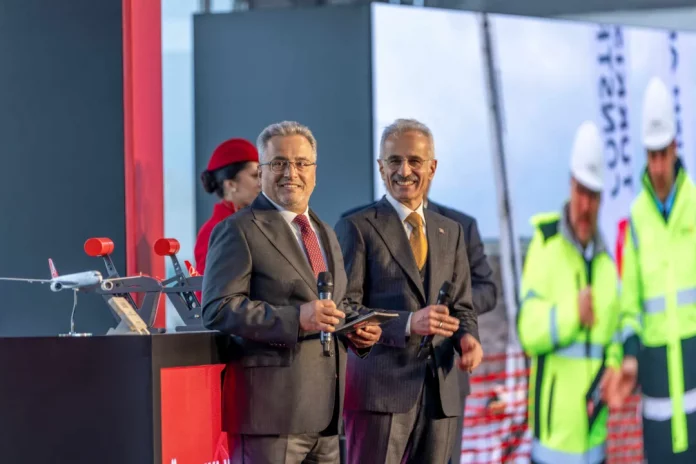
The investment programme forms part of Turkish Airlines’ long-term 2033 vision and was marked by groundbreaking ceremonies for eight new facilities, primarily located at Istanbul Airport. The events were attended by Türkiye’s Minister of Transport and Infrastructure Abdulkadir Uraloğlu, Turkish Airlines Chairman of the Board and Executive Committee Prof. Ahmet Bolat, along with senior executives and aviation stakeholders.
Minister Uraloğlu said the projects represented a major milestone for Türkiye’s aviation sector, describing them as a decisive step toward strengthening the national carrier’s global position. He noted that the SmartIST Phase 2 project would significantly expand both the physical footprint and operational capability of the cargo terminal, enabling Turkish Cargo to scale its global operations. According to the ministry, the overall investment is expected to generate 26,000 new jobs in 2026, supporting wider economic growth.
Prof. Bolat said the programme goes beyond fleet growth, focusing on building the infrastructure required to fully support Turkish Airlines’ future operations. He stated that the TRY 100 billion initiative would strengthen the carrier’s competitiveness while helping position Türkiye as a leading global aviation hub. Bolat added that employment created by the projects is expected to rise to 36,000 once all phases are completed, while Turkish Airlines’ total economic contribution is forecast to increase from USD 65 billion today to USD 144 billion by 2033.
Major Infrastructure Projects
As part of the investment drive, Turkish Airlines is advancing multiple large-scale projects across cargo, maintenance, catering and digital operations:
-
SmartIST Cargo Terminal Phase 2
Set to become one of the world’s largest air cargo centres, the expanded facility will offer an annual capacity of 4.5 million tonnes, with phased completion planned between 2027 and 2028. -
Main Catering Facility
Designed as one of the world’s largest inflight catering centres, the new complex will be capable of serving more than 500,000 passengers per day and is expected to enter service during 2027–2028. -
Turkish Technic Engine Maintenance Center
Scheduled for completion in 2027, the facility will rank among Europe’s largest next-generation engine maintenance centres, supporting Rolls-Royce Trent XWB-84, Trent XWB-97 and Trent 7000 engines. -
Additional Aircraft Maintenance Hangars
Planned for completion in 2026, these hangars will increase simultaneous maintenance capacity by 12 aircraft, boosting overall maintenance capability by approximately 20%. -
E-Commerce Complex
Due to become operational in 2026, the complex will support Turkish Airlines’ digital logistics strategy through Widect, its integrated “door-to-door” cargo solution. -
Istanbul Data Center
Expected to come online in 2027–2028, the data centre will provide high-security digital infrastructure to support operational continuity and advanced data management. -
Flight Training Center (Phase 1)
Planned for the 2026–2027 period, the facility will support long-term workforce development as fleet and operations expand. -
Additional Crew Terminal Building
Scheduled for completion in 2026, the terminal will support growing operational volumes and improve logistical integration between flight operations, maintenance and ground services.
Together, the projects form the backbone of an integrated growth model supporting Turkish Airlines’ ambition to operate one of the world’s five largest fleets by its centenary in 2033, while strengthening Türkiye’s role as a global aviation and logistics hub.