

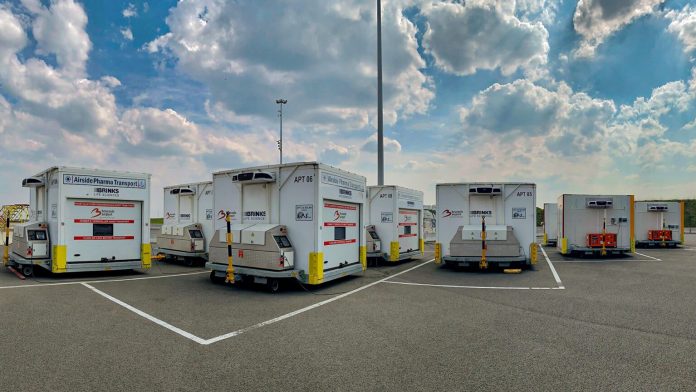

The first test shipments of human cell and blood material representative of precision therapies, including treatments for cancer and rare diseases, have departed from Brussels Airport to Dallas (US).
The shipments are part of the Precision Therapy Logistics Gateway (PTLG) project. This project analyses how precision therapies can be transported safely and quickly worldwide and identifies risks within existing logistics processes.
Following the test shipments, Brussels Airport and its project partners aim to become the first airport to develop an internationally recognised standard for the air transport of these treatments.
Options for setting up a specialised logistics centre at the airport are also being explored.
Since November, 10 test shipments of cell and blood samples have been sent from Brussels Airport to BioLabs Pegasus Park, a biotech cluster in Dallas, USA.
The test shipments were transported successfully. Another 50 shipments are scheduled in the coming weeks.
Precision therapies, including cell, gene and radioligand therapies, are personalised treatments for individual patients. As they are highly sensitive, they require fast, reliable transport under strictly controlled conditions, including temperature and lead time.
at.las, the Antwerp ecosystem for Advanced Therapy Medicinal Products (ATMP) and the Science Park University of Antwerp in Niel are coordinating the test shipments.
The Laboratory of Experimental Haematology at the University of Antwerp provides the research samples.
This cell and blood material, sourced from healthy donors, is transported from the Centre for Cell Therapy and Regenerative Medicine (CCRG) of the Antwerp University Hospital (UZA) to the airport. Upon return from Dallas, the test shipments arrive back at the CCRG.
Expertise in the transport of pharmaceutical goods
As Europe’s preferred pharma hub, Brussels Airport has extensive expertise and facilities for the transport of time and temperature-sensitive pharmaceutical goods, with a total capacity of approximately 45,000 m² of temperature-controlled storage space in the cargo area.
Upon arrival at Brussels Airport, the test shipments go through customs control and are stored in a temperature-controlled zone while waiting for the flight.
They are then transferred to the aircraft in refrigerated containers developed by Brussels Airport itself ten years ago, ensuring optimal conditions during transport.
In Dallas, the material is transported to a laboratory at BioLabs Pegasus Park, where it undergoes a visual inspection before being returned to Belgium.
In Dallas, the material is transported to a laboratory at BioLabs Pegasus Park, where it undergoes a visual inspection before being returned to Belgium.
These are relatively small consignments transported as cargo on board passenger flights.
This logistics model ensures that patients do not need to travel themselves; instead, their cellular material does, which significantly increases treatment accessibility.
Arnaud Feist, CEO of Brussels Airport, said: “With this project, we are strengthening our role as a pioneer in pharma logistics, not only in Europe but worldwide.
“The production and use of precision therapies in Belgium will increase significantly in the coming years.
“This calls for a logistics approach in which speed, accuracy and reliability are essential. Together with our partners, we are putting our expertise at the service of this important innovation to contribute to the healthcare of the future”.
Sensors are added to the shipments to monitor critical parameters such as lead times, temperature control and traceability throughout the logistics process.
This enables the identification of potential risks and bottlenecks across the transport chain.