

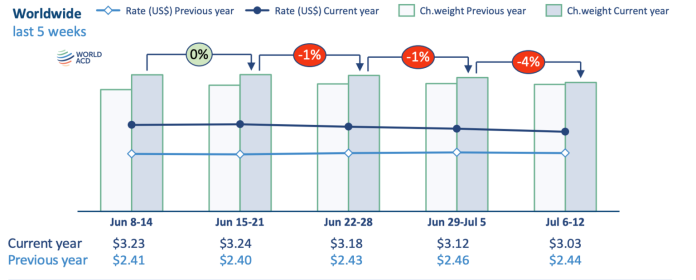

Worldwide air cargo tonnages and rates edged downwards in the second week of July, according to the latest weekly figures from WorldACD Market Data, as stakeholders adjusted to the renewed escalation of the US-Iran conflict and EU import changes, while East Asia was impacted by a typhoon.
Global tonnages fell by -4%, week on week (WoW), in week 28 (6 to 12 July), driven largely by a -7% WoW drop in volumes from Asia Pacific origins, partly due to the effects of typhoon Bavi, which particularly affected capacity and chargeable weight from Taiwan and to a lesser extent volumes and capacity from China and other parts of East Asia.
Asia Pacific volumes impacted by typhoon and new EU import rules
Tonnages from Taiwan to the US in week 28 fell by -11%, WoW, although there was also a -17% drop from Vietnam to the US, and WoW declines from other significant Asia Pacific origin countries including Malaysia (-7%), Indonesia (-7%), and China (-5%), taking Asia Pacific to US volumes down -5%. Nevertheless, they remain +11% higher than this time last year, with significant year-on-year (YoY) increases from most Asia Pacific countries to the US with the exception of Taiwan (-15%) and Hong Kong (-3%).
Meanwhile, tonnages from Asia Pacific to Europe were down, WoW by -10% in week 28, and were -15% below their level this time last year. Although volumes from Taiwan to Europe suffered the biggest declines in percentage terms, down by -24%, WoW, the much bigger decline in tonnage terms was from China, where volumes were down -13%, WoW and down -15%, YoY. Also, volumes from Hong Kong were down -23%, YoY, after four consecutive WoW declines, reflecting the impact of the removal by the EU of de minimis import tariff exemptions since 1 July.
Chargeable weight from Middle East & South Asia (MESA) origins declined by -4%, WoW, with capacity from the region down -3%, WoW, and from Gulf countries by -4%, linked to the escalating conflict between Iran and the US. Tonnages from MESA to the US were particularly affected, dropping in week 28 by around -14%, WoW – declines experienced relatively evenly across much of the region. But chargeable weight from MESA to Europe was actually up +4%, WoW, and similar to the levels in the equivalent week last year.
Rates continue falling
On the pricing side, average worldwide rates, based on a mix of contract rates and spot rates, continued falling in week 28, their third consecutive WoW decline, dropping -3% to US$3.03 per kilo, although that remains +24% higher than this time last year. Global average spot rates declined also by -3% WoW to $3.47 per kilo, standing at +32%, YoY. The biggest WoW spot rate declines in percentage terms were from Africa (-8%), MESA (-4%), Europe (-4%), and Asia Pacific (-2%), whereas they rose by +3% from North America in week 28, the week following Independence Day in the US.
Spot rates from Asia Pacific to the US were relatively stable in week 28, declining by just -2%, WoW, to $6.68 per kilo, +37% higher than the equivalent week last year. But from Asia Pacific to Europe, softening demand in the last few weeks was reflected in a third consecutive drop in week 28 (-5%, WoW) in average spot rates to $4.82 per kilo, led by a -9% WoW fall from China origins to $4.45 per kilo. Although average Asia Pacific to Europe spot rates remain +25% higher, YoY, China to Europe spot rates were just +15% higher, YoY, in week 28 – the smallest YoY percentage gain since the end of March. Indeed, China to Europe spot rates and average Asia Pacific to Europe spot rates have both dropped back to levels last seen in late March.