


Market shows signs of stability
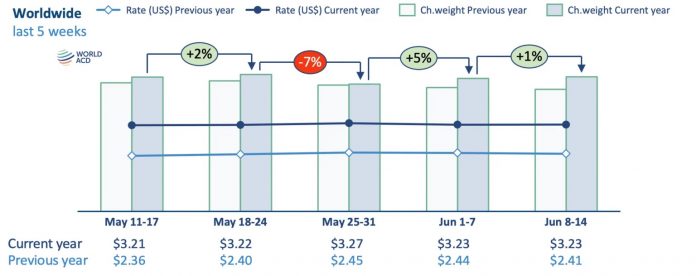
Despite a temporary flare-up of the conflict in the Middle East, the global air cargo market was stable in week 24 (June 8 to 14). Traffic volume, capacity and pricing showed only moderate changes from the previous week.
Worldwide tonnage increased +1% week on week (WoW), the latest figures from WorldACD Market Data show. Volumes declined -5% and -1% out of Central & South America (CSA) and North America, respectively, but rose between +2% and +4% from the other regions, led by the Middle East & South Asia (MESA). In some cases, such as with global exports from North America, volumes retreated after strong rebounds the week before when trade had picked up from slowdowns caused by national holidays. Based on the last two weeks, chargeable weight from North America grew +10%, when comparing with the prior two weeks (2Wo2W), driven by the post US Memorial Day recovery.
The 2Wo2W comparison also reflects the overall stability of traffic, which shows global volume up +1%, while pricing remained flat. Likewise, capacity was unchanged WoW as well as 2Wo2W. Year on year (YoY) total chargeable weight was up +10%, driven by double-digit growth out of MESA (+22%), followed by Africa (+14%) and Asia Pacific (+12%), while Europe (+8%), North America (+6%) and CSA (+2%) registered single-digit expansion.
Air cargo volume from Asia Pacific to Europe rose +2% WoW but sank -2% to USA. Chargeable weight to Europe slightly declined out of Indonesia and was flat out of China and Japan, but grew in low single digits out of all other origins, except for Singapore growing +9% and Malaysia +36% (after dropping -20% each week the previous two weeks). The decline of chargeable weight from Asia Pacific to USA was the result of single-digit drops out of Thailand, Vietnam, China and Japan, which exceeded gains from the other origins in the region.
Hostilities do not halt MESA recovery
As hostilities in the Gulf region resumed early in the week last week, capacity out of MESA declined -2% WoW after a +9% surge the week before. Capacity was flat out of all other origins except CSA, which saw an increase of +1%.
Traffic out of the Middle East was not reduced related to this escalation, growing +4% WoW, driven by a continued post-Eid al-Adha recovery. Chargeable weight from MESA to Europe increased +2% WoW, thanks to a +24% increase from Bangladesh and +12% from Dubai, whereas volumes out of Sri Lanka and India retreated -14% and -6%, respectively. Chargeable weight from MESA to USA slipped -1% WoW, due to declines of -21% from Sri Lanka and -3% from India. Chargeable weight jumped +72% WoW from Bangladesh (after dropping by -60% the two weeks before, combined) and +9% from Dubai.
Stable pricing
At $3.23 the global average rate was unchanged WoW, and pricing was also flat on a 2Wo2W basis. Except for a moderate spike in week 22, it changed little during the past four weeks. A breakdown by origin region shows a +1% WoW increase out of Europe and drops of -1% from Asia Pacific and MESA, with average pricing from the other regions unchanged. Year on year overall pricing was up +34%, with increases ranging from +11% ex-CSA to +48% ex-MESA.
Spot pricing from Asia to USA notched up another +1% WoW, continuing a +1% run each consecutive week starting from week 20. Last week it was flat out of Taiwan, Vietnam and Indonesia while rising in single digits out of all other Asian origins except Japan, where spot rates dropped -12%. The average spot rate from Asia Pacific to Europe was flat WoW for the third consecutive week. Spot prices increased between +1% and +5% out of Hong Kong, China, Indonesia and Singapore and were flat from Vietnam, but declined from the other origins, led by a -10% drop out of Thailand.
The preliminary agreement between the USA and Iran to end the conflict promises – if it holds – a more stable situation in the Middle East leading to increased flows through the region, but it will take some time before passenger flights are back to pre-conflict levels. Likewise, oil prices, which already decreased in week 24 (-5% WoW), should descend further, but a return to full capacity of oil production is expected to be months away, keeping rates at elevated levels for the coming period.