


June tonnages up +9% on last year while spot rates slightly soften
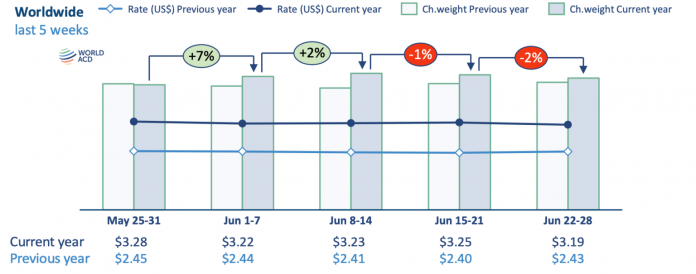
Worldwide air cargo tonnages and rates in June and for the first half of 2026 were well up on last year’s levels, although tonnages and rates edged downwards in the final full week of June, declining both by -2% on a week-on-week (WoW) basis.
According to the latest figures from WorldACD Market Data, global tonnages in June were +9% higher than the same month last year, and stable compared to May, taking volumes for the second quarter (Q2) +6% higher, year on year (YoY), and also +6% above their level in Q1. Chargeable weight for the first half (H1) of 2026 was up +5%, YoY, as air cargo growth has continued this year despite the disruptions to capacity and markets in the Middle East, led by a +8% YoY H1 increase in tonnages from Asia Pacific origins.
The strong June YoY tonnage growth was shared by most of the main air cargo origin regions, led by YoY increases from the Middle East & South Asia (MESA, +11%, partially driven by Eid al-Adha held in May this year vs June last year), Asia Pacific (+10%) and North America (+9%), with Europe (+7%) and Central & South America (CSA, +7%) also contributing with healthy growth levels, while Africa’s growth was more subdued (+1%).
Spot rates stable in June
Worldwide air cargo rates, meanwhile, remained high in June, despite the ongoing return of capacity to Middle East and Gulf markets, with average full-market rates around one third (+33%) higher, YoY, for June and for Q2 as a whole, based on a combination of spot rates and contract rates. Average rates for Q2 were also well above (+28%) their average level in Q1, illustrating how significantly the market has changed since the US and Israel began their military campaign against Iran on 28 February.
Average worldwide spot rates in June of US$3.71 per kilo were broadly stable compared with their level of the previous month, but year on year the increase reduced from +49% in May to +43% in June. The YoY increase in June was driven by +49% from MESA and Africa origins, +47% from Asia Pacific, and also with substantial YoY increases from North America (+42%) and Europe (+34%), while spot rates from CSA were up by a relatively modest +14%, YoY.
Despite continuing volatility and some renewed flare-ups in the confrontation between the US and Iran, the relative stability in the situation since the two sides signed a memorandum last month has led to a further fall in jet fuel prices, which dropped by another -2%, WoW, to below $117 per barrel in the week ending 26 June, while Brent crude fell by -9% to below $74 per barrel, according to IATA’s Jet Fuel Price Monitor, which is based on the latest price data from Platts. Various carriers have announced reductions in their respective air cargo fuel surcharges from 1 July, with further reductions likely to translate into an easing of overall air cargo rates in the coming weeks.
Capacity recovery continues
Those pricing dynamics also depend on the wider supply and demand situation across key markets, and the relative stability of the US-Iran situation in the last few weeks has helped support a continuing stabilization of air cargo capacity to and from Gulf markets. Based on a comparison of the last two weeks with the preceding two weeks (2Wo2W) worldwide air cargo capacity increased +3%, mainly driven by origin region MESA (+5%), followed by North America (+4%) and Europe (+3%). That took worldwide air cargo capacity +3% higher than this time last year – with capacity from MESA origins now also back slightly above last year’s levels (+1%, YoY).
Limited effects of 1 July EU rule change
In contrast to the ‘front-loading’ that took place last year ahead of various US import tariff deadlines and the removal of US ‘de minimis’ exemptions, there was little sign of air cargo ‘front-loading’ ahead of the 1 July change of EU de minimis rules, which introduce a €3 fixed-fee customs payment per item or tariff code for shipments valued less than €150 that are imported into the EU. Air cargo volumes from China and Hong Kong to Europe fell by -8% and -9%, WoW, respectively, in the last full week of June (week 26: 22 to 28 June), after also recording a small WoW decline the previous week.
One explanation is that lessons have been learned since the end of US de minimis exemptions last year, and there are now low-cost customs filing solutions available that can limit the costs of customs declarations to just a few cents per item, compared with several dollars per item last year at the time of the removal of US de minimis exemptions.
There were also WoW tonnage declines to Europe in week 26 from other important Asia Pacific export markets, such as Vietnam (-7%) and Thailand (-9%), contributing to an average -7% WoW fall in tonnages from Asia Pacific to Europe. Average spot rates from Asia Pacific to Europe edged downwards slightly (-2%, WoW) to $5.26 per kilo in week 26, but they remain +38% higher, year on year.